


Healthcare in Dubai: 1970s Clinics vs Smart Hospitals (2026)
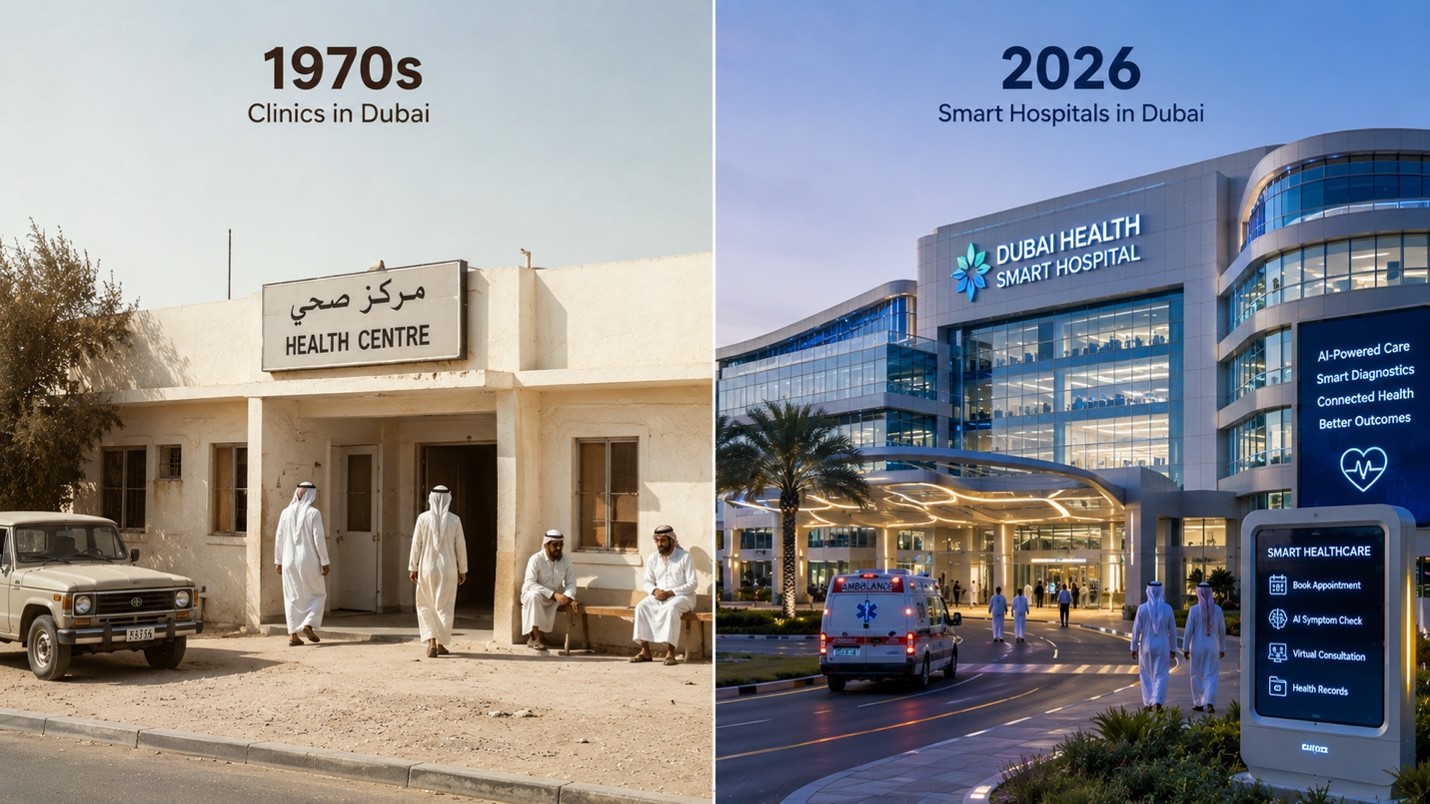
Then: Basic Clinics in the 1970s
In the 1970s, healthcare in Dubai was a far cry from the world-class medical infrastructure the emirate is known for today. Most residents relied on a small number of government clinics and a handful of basic hospitals, the most notable being Rashid Hospital, which opened in 1973 and was, for years, the primary medical facility serving the entire population. Equipment was limited, specialist doctors were scarce, and many serious medical cases had to be referred abroad, often to hospitals in India, the United Kingdom, or other parts of the Gulf, simply because the necessary expertise or technology did not yet exist locally.
Before the opening of Rashid Hospital, healthcare access in Dubai was even more rudimentary. Small dispensaries and a handful of foreign-run missionary clinics provided the bulk of medical care available to the population. Maternity services, vaccination programmes, and basic surgical care were the priorities, while anything resembling specialised treatment for cardiology, oncology, or complex orthopaedic conditions was essentially unavailable within the emirate’s borders. Many Emirati families have stories passed down of relatives travelling by sea or early flights to seek treatment that simply could not be found at home.
Public health challenges of the era reflected the broader development status of the region. Infectious diseases, malnutrition in some communities, and limited access to clean water in outlying areas posed ongoing challenges for the small number of doctors and nurses working across the emirate. Medical staff were predominantly expatriates recruited from Egypt, India, Pakistan, and the United Kingdom, since the local pool of trained healthcare professionals was still extremely limited in a society where formal medical education had barely begun to take root.
Despite these constraints, the 1970s marked the beginning of serious government investment in healthcare infrastructure. Sheikh Rashid bin Saeed Al Maktoum recognised early that a modern healthcare system was essential to Dubai’s broader development ambitions, and oil revenues were increasingly directed toward expanding medical facilities, training programmes, and public health initiatives. It was a slow and incremental process, but the foundation being laid in this decade would prove critical to everything that followed.
Now: World-Class Smart Hospitals in 2026
In 2026, Dubai’s healthcare system stands among the most advanced in the world, combining cutting-edge medical technology with a regulatory framework designed to attract top international talent and investment. The Dubai Health Authority, now operating under the unified Dubai Health umbrella, oversees a network of hospitals, clinics, and specialty centres that serve both the local population and a growing stream of medical tourists who travel to Dubai specifically for treatment. The emirate has positioned itself as a regional and global hub for medical tourism, competing directly with established destinations in Asia and Europe.
Smart technology is now embedded throughout the patient experience. Many Dubai hospitals utilise artificial intelligence for diagnostic imaging analysis, predictive patient monitoring, and administrative efficiency. Robotic-assisted surgery is available across multiple major hospitals, allowing for greater precision in procedures ranging from cardiac surgery to orthopaedic joint replacement. Electronic health records are fully integrated across the public health system through the Nabidh platform, allowing doctors at different facilities to access a patient’s complete medical history instantly, reducing errors and improving continuity of care.
Dubai Healthcare City, established as a dedicated free zone for medical services, has grown into a sprawling campus of hospitals, clinics, research centres, and academic medical institutions. International names including the Mayo Clinic, Moorfields Eye Hospital, and various American and European medical brands operate within this district, offering world-class specialist treatment that would have been unimaginable to access locally just a few decades ago. The free zone framework allows these institutions to operate with international standards of practice while serving patients from across the Middle East, Africa, and South Asia.
From a handful of basic clinics in the 1970s to an AI-integrated, globally competitive healthcare ecosystem in 2026, Dubai’s medical transformation mirrors the broader story of the city itself. What was once a system defined by scarcity and necessity has become one defined by abundance and ambition, offering residents and visitors access to some of the most advanced medical care available anywhere on Earth.
Contributed by GuestPosts.biz