


Dubai Education: 1960s Schools vs Smart Learning (2026)
Then: Dubai’s Earliest Schools in the 1960s
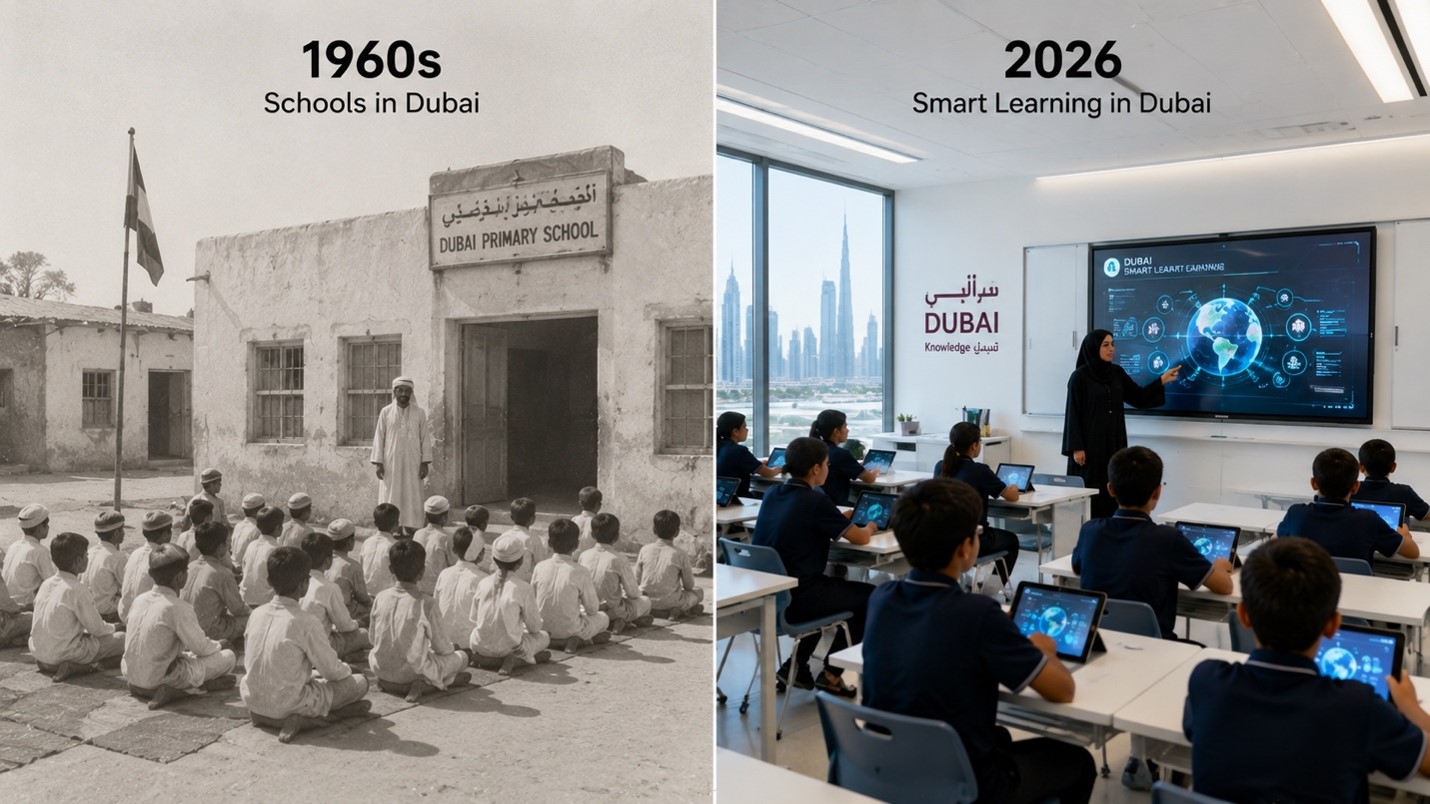
Formal education in Dubai before the 1960s was extremely limited, rooted primarily in small Quranic schools known as Kuttab, where children learned to read and recite the Quran alongside basic literacy and arithmetic. These informal settings, often held in mosques or the homes of religious teachers, represented the only structured learning available to most children, and even this level of access was far from universal. Many families, particularly in fishing and pearl-diving communities, prioritised work over education, with children expected to contribute to household income from a young age.
Al Ahmadiya School, founded in 1912 in the Deira district, stands as one of the earliest formal schools in Dubai’s history and remains a celebrated heritage site today. However, even by the 1960s, the number of schools across the entire emirate could be counted on two hands. Classrooms were basic, often a single room with students of varying ages grouped together, taught by a small number of educators using limited textbooks and minimal teaching materials. Subjects were narrow in scope, focusing primarily on Arabic language, religious studies, and basic mathematics.
Girls’ education was even more constrained during this period, with cultural norms of the time limiting formal schooling opportunities for young women in many communities. It was not until the late 1960s and early 1970s, supported by growing government investment and changing social attitudes, that girls’ education began to expand meaningfully across Dubai. The first government-run public schools, established with support from neighbouring Kuwait and Egypt before the formation of the UAE in 1971, marked the beginning of a more structured national education system.
The teaching workforce in 1960s Dubai was almost entirely composed of expatriate educators, recruited primarily from Egypt, Jordan, and Palestine, since a domestic pool of trained Emirati teachers had not yet developed. Resources were scarce, school buildings were modest, and the overall literacy rate across the population remained low by international standards. Yet even in these early years, the seeds of a much larger ambition were being planted, as Dubai’s leadership recognised education as fundamental to the emirate’s long-term development.
Now: Smart Learning and Global Education in 2026
In 2026, Dubai’s education landscape is almost unrecognisable from its modest 1960s origins. The emirate is home to hundreds of schools spanning dozens of curricula, including British, American, Indian, IB, French, and UAE national curricula, reflecting the extraordinary diversity of Dubai’s resident population. Private international schools dominate the K-12 landscape, with many ranked among the top-performing institutions globally according to international assessment benchmarks, and competition for places at the most sought-after schools is intense among Dubai’s expatriate and Emirati families alike.
Technology has become deeply embedded in Dubai’s classrooms. The Knowledge and Human Development Authority, which regulates private education in Dubai, has actively promoted the integration of smart learning tools, including AI-powered adaptive learning platforms, virtual reality classroom experiences, and comprehensive digital learning management systems. Many schools now operate with one-to-one device programmes, where every student has access to a tablet or laptop integrated directly into the curriculum, a level of technological saturation that would have been unimaginable to the educators of the 1960s.
Higher education has also flourished dramatically. Dubai now hosts dozens of international university branch campuses within Dubai International Academic City and Dubai Knowledge Park, including outposts of universities from the United Kingdom, the United States, Australia, India, and Russia. Students can pursue globally recognised degrees without leaving the emirate, a stark contrast to earlier generations of Emiratis who often had to travel abroad for any form of tertiary education. Government-led initiatives continue to invest heavily in STEM education, artificial intelligence literacy, and entrepreneurship training to prepare students for a rapidly evolving global economy.
From single-room religious schools in the 1960s to AI-integrated, internationally accredited campuses in 2026, Dubai’s educational transformation reflects the emirate’s core philosophy: that investment in human capital is the truest foundation for long-term prosperity. What was once a system struggling with basic literacy has become one of the most sophisticated and diverse education ecosystems anywhere in the world, preparing generations of students for a future that Dubai itself helped to imagine.
Contributed by GuestPosts.biz