

Dubai Internet City: Launch (2000) vs Global Tech Hub (2026)
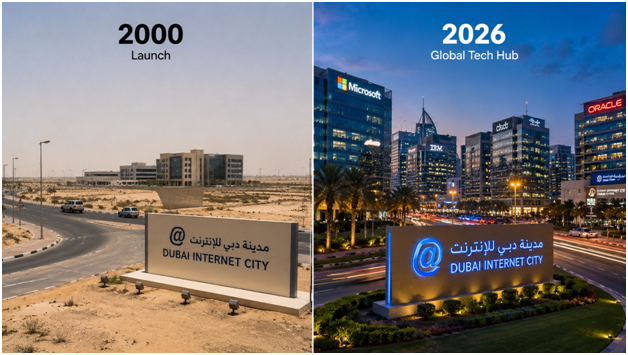
Then: Dubai Internet City at Launch (2000)
When Dubai Internet City officially launched in October 2000, it was a statement of intent that few in the technology world fully understood at the time. The world was still reeling from the dot-com bubble that had inflated and was about to burst, and the idea of a Middle Eastern emirate positioning itself as a global technology hub seemed to many observers wildly premature. Yet Sheikh Mohammed bin Rashid Al Maktoum had made a calculated decision rooted not in the trends of the moment but in a long-term vision of what Dubai needed to become in a post-oil future. Dubai Internet City was not a reaction to the tech boom. It was a declaration of the kind of economy Dubai intended to build.
The site chosen for Dubai Internet City was a stretch of desert land along Sheikh Zayed Road in what was then the relatively undeveloped southern corridor of the emirate. The infrastructure was built at remarkable speed. The entire first phase of the free zone, including office buildings, fibre optic networks, data connectivity, and supporting amenities, was completed in just eleven months from groundbreaking to opening. This pace of construction was itself a marketing statement, signalling to international technology companies that Dubai could deliver on its promises with a speed that no other emerging market could match.
At its launch, Dubai Internet City attracted major technology names that lent the project immediate credibility. Microsoft, Oracle, Cisco, HP, and IBM were among the early tenants, drawn by a package of incentives that included 100% foreign ownership, zero corporate and personal income tax, full repatriation of profits, and a streamlined regulatory environment. For global tech firms looking to access the Gulf, Africa, and South Asian markets from a single base, Dubai Internet City made an immediately compelling case.
In those early years, the free zone was a modest collection of low-rise office buildings arranged around a central lake, surrounded by construction sites and open land. The community of tech professionals working within its boundaries was small but energetic, animated by the novelty of building something entirely new in a part of the world not previously associated with the technology industry. There was a frontier spirit to the place, a sense that the rules were being written in real time and that the opportunities were genuinely limitless.
Now: Dubai Internet City as a Global Tech Powerhouse (2026)
In 2026, Dubai Internet City is one of the most significant technology business ecosystems in the world. Home to over 1,600 companies and more than 30,000 knowledge workers, the free zone has grown far beyond its original boundaries and now forms the anchor of a broader technology and media district that includes Dubai Media City, Dubai Studio City, and the sprawling hub that houses GITEX Global. GITEX is one of the world’s largest and most influential technology exhibitions, drawing hundreds of thousands of visitors and thousands of exhibiting companies to Dubai every October, firmly placing the city on the global technology calendar.
The roster of companies operating within Dubai Internet City in 2026 reads like a who’s who of the global technology industry. Google, Meta, LinkedIn, Siemens, SAP, Huawei, Tencent, and hundreds of regional and international technology firms have established offices, regional headquarters, or innovation centres within the free zone or its surroundings. The concentration of technology talent, capital, and corporate infrastructure in this district has made it the undisputed centre of the digital economy in the Middle East, Africa, and South Asia region — a combined market of over two billion people that Dubai is uniquely positioned to serve.
The startup ecosystem that has grown around Dubai Internet City is particularly noteworthy. In 2000, the concept of a Gulf-based technology startup was virtually nonexistent. By 2026, Dubai has produced dozens of unicorn-level technology companies and become a leading destination for venture capital investment in emerging markets. Government initiatives including the Dubai Future Foundation, Area 2071, and the Dubai Artificial Intelligence Roadmap have created a structured environment in which startups can access funding, mentorship, regulatory sandboxes, and government procurement opportunities with unprecedented ease.
From eleven months of desert construction in 2000 to a globally recognised technology powerhouse in 2026, Dubai Internet City tells the story of a city that bet on knowledge before knowledge was fashionable in its region. That early wager has paid off beyond any reasonable expectation. Today, when technology companies look to establish a presence that bridges East and West, they do not ask whether to come to Dubai. They ask only how quickly they can get here.
Contributed by GuestPosts.biz