


Dubai Marina: Empty Desert (1990s) vs Waterfront Skyline (2026)
Then: The Empty Desert of the 1990s
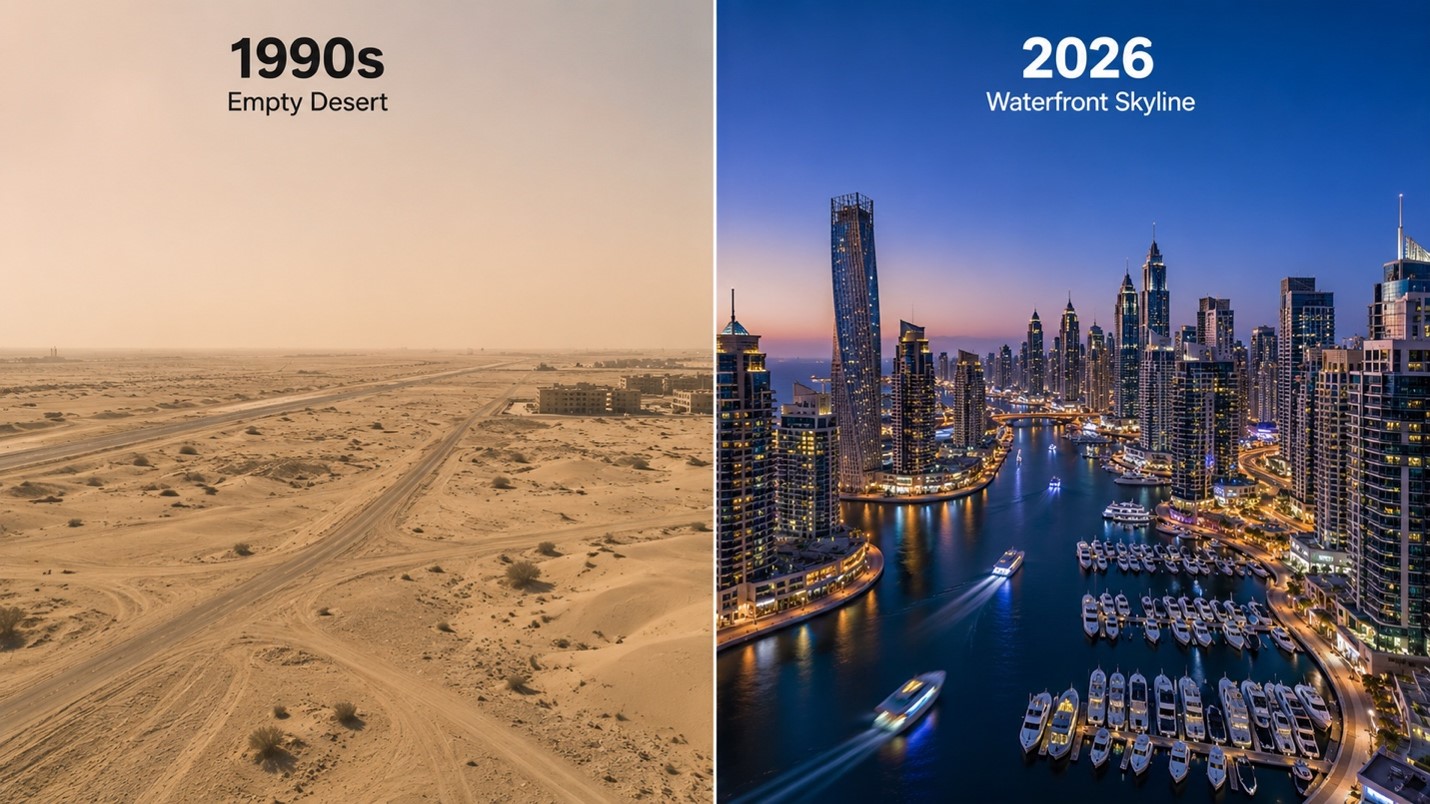
It is almost impossible to stand on the Dubai Marina waterfront today and imagine what the same stretch of land looked like in the early 1990s. Where gleaming towers now pierce the sky, where yachts bob gently in a man-made canal, and where cafés and restaurants spill out onto promenades lined with palm trees, there was once nothing but flat, sun-baked desert stretching uninterrupted to the edge of the Arabian Gulf. The area known today as Dubai Marina was, for most of the twentieth century, an unremarkable expanse of coastal sand with no permanent settlement, no infrastructure, and no particular significance beyond its proximity to the sea.
The land that would become Dubai Marina sat to the south of the older, more established parts of the city. Throughout the 1980s and into the 1990s, Dubai’s development was concentrated in Deira, Bur Dubai, and the areas immediately surrounding the creek. The southern coastal strip – which would later become the New Dubai corridor encompassing the Marina, Jumeirah Beach Residence, and the Palm Jumeirah – remained largely untouched. A few kilometres of empty beach, the occasional fishing spot, and the vast silence of undeveloped Gulf coastline defined the character of the area entirely.
The master plan for Dubai Marina was conceived by Emaar Properties and approved in the late 1990s, with construction beginning around 1999 and 2000. The plan was extraordinarily ambitious: to create a entirely new urban district from scratch, centred around a two-kilometre artificial canal dug from the Arabian Gulf and lined with residential towers, hotels, retail spaces, and public promenades. The canal itself required massive dredging and engineering work to carve out of the existing landscape. When the project was first announced, many observers found the scale of the vision difficult to comprehend. A new city within a city, built on desert sand, in under a decade – it sounded like fantasy.
In the early 2000s, as construction cranes began to appear on the horizon and the first foundations were laid, the transformation from desert to urban district was just beginning. Early buyers who purchased off-plan apartments in those first towers were making a leap of faith, trusting that what existed only as architectural renderings and marketing brochures would one day become a real, living neighbourhood. As it turned out, their faith was more than rewarded.
Now: Dubai Marina as a World-Class Waterfront (2026)
In 2026, Dubai Marina is one of the most densely populated and visually dramatic urban waterfront districts anywhere in the world. The skyline that has risen above the man-made canal is a jaw-dropping collection of some of the tallest residential towers ever built, including the iconic Cayan Tower – a 73-storey skyscraper that twists 90 degrees from base to pinnacle – and the Princess Tower, which held the title of the world’s tallest residential building for several years after its completion. Over 200 towers now define the Marina skyline, housing tens of thousands of residents and creating one of the most distinctive urban silhouettes on the planet.
The Marina Walk, a 7-kilometre promenade that runs the full length of the canal on both sides, has become one of Dubai’s most beloved public spaces. Lined with restaurants, cafés, juice bars, boutiques, and leisure facilities, it is busy at virtually every hour of the day and night. Residents jog along its paths in the early mornings, families stroll during the cooler evenings, and tourists explore its waterside dining options throughout the weekend. The tram that runs along the Marina and connects to the metro at two interchange stations has made the district seamlessly accessible from the rest of the city.
The marina basin itself is home to hundreds of private yachts and leisure boats, with berthing facilities managed by dedicated marina operators. Boat tours, sunset cruises, and water sports activities depart daily from the waterfront, offering residents and visitors alike a direct connection to the Arabian Gulf. The area is also home to Dubai Marina Mall, a mid-sized shopping centre that serves the dense residential population of the district, as well as numerous five-star hotels including the Address Dubai Marina and the Grosvenor House.
From empty coastline in the 1990s to one of the most recognisable urban waterfronts in the world by 2026, Dubai Marina represents perhaps the purest expression of what Dubai does best – taking a blank canvas and filling it with something that astonishes. The district was not discovered or evolved organically over centuries. It was imagined, engineered, and built within a single generation, and it stands today as proof that in Dubai, ambition and execution are one and the same thing.
Contributed by GuestPosts.biz