


Burj Al Arab: Blueprint (1994) vs Global Luxury Symbol (2026)
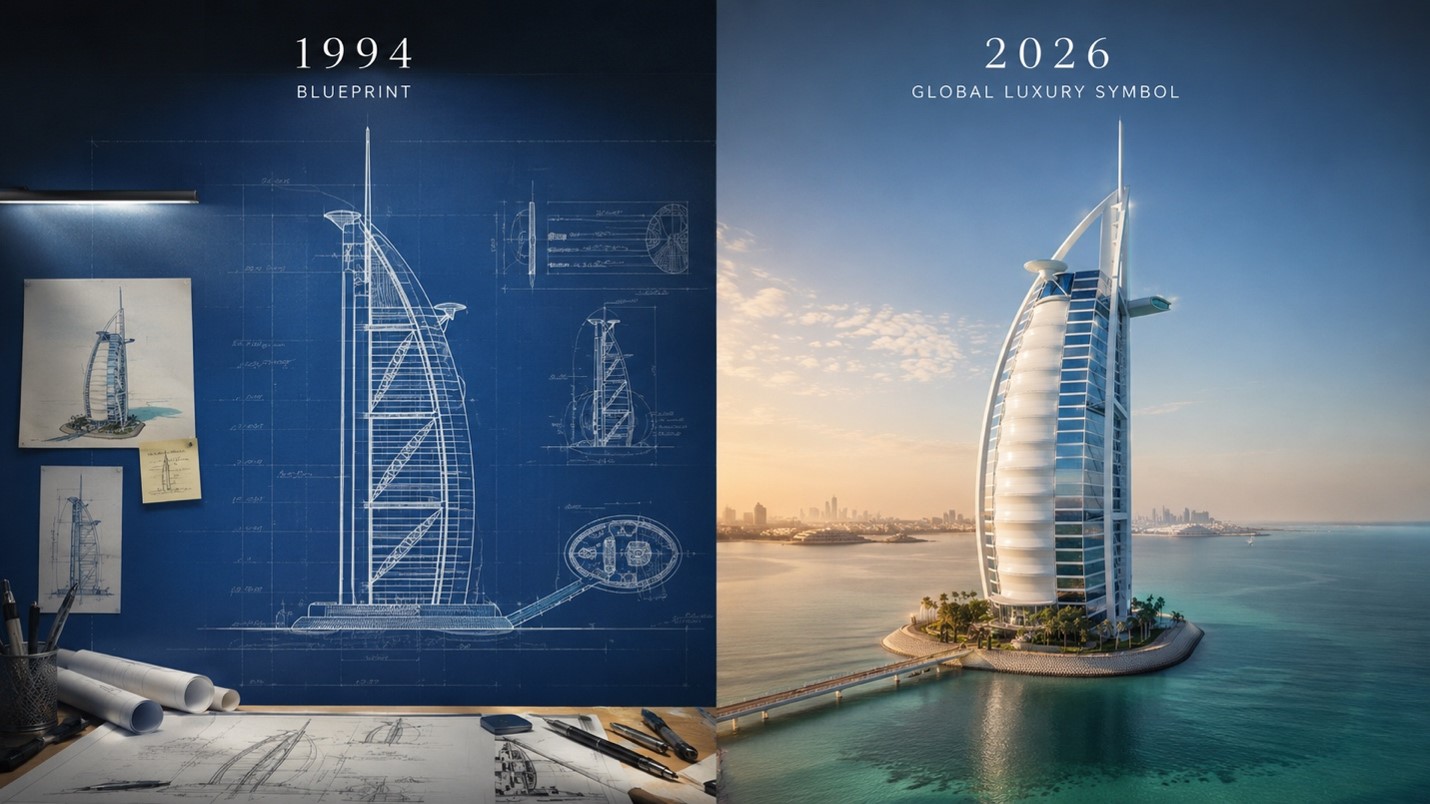
Then: The Blueprint and Vision Behind Burj Al Arab (1994)
In 1994, the stretch of Jumeirah coastline where the Burj Al Arab now stands was nothing more than open sea and sandy beach. The idea that a hotel – not just any hotel but one that would redefine global luxury hospitality and become one of the most photographed buildings in the world – was about to be born from the waters of the Arabian Gulf was known only to a small circle of architects, engineers, government officials, and the visionary ruler who had commissioned it. Sheikh Mohammed bin Rashid Al Maktoum had a simple but audacious brief for the project: build a hotel that would put Dubai on the world map. What emerged from that brief was one of the most remarkable architectural and hospitality achievements of the twentieth century.
The design contract was awarded to the British architectural firm W.S. Atkins, and the lead architect was Tom Wright, who produced the now iconic concept of a building shaped like the billowing sail of a traditional Arabian dhow. The choice was deeply symbolic – connecting the new structure to Dubai’s maritime trading heritage while simultaneously projecting a bold, forward-looking image that would photograph beautifully from every angle. The decision to build the hotel on its own artificial island, connected to the mainland by a private curved bridge, was both a practical solution to the limited beach frontage and a masterstroke of marketing, adding to the sense of the hotel as a destination unto itself, separated from the ordinary world by a literal body of water.
Construction began in 1994 and presented enormous engineering challenges from the outset. Building on a man-made island in the Arabian Gulf required the driving of 230 concrete piles into the seabed, each 40 metres long, to create a stable foundation in the sandy, shifting seafloor. The process of creating the island itself took roughly three years before the tower construction could begin in earnest. The building’s distinctive exoskeleton – a steel diagrid structure that gives the sail its characteristic curved shape – required fabrication techniques that pushed the limits of what was achievable with the technology of the mid-1990s. Every phase of the project was a first.
The interior design vision was equally ambitious. The commission to design the interior went to Khuan Chew, who created a concept of layered opulence that used gold leaf, rare marbles, hand-woven carpets, and a colour palette of deep blues, reds, and golds to create an atmosphere of Arabian luxury unlike anything that had been attempted in hotel design before. The atrium, at 180 metres the tallest in the world at the time of opening, was designed to flood with natural light and create a sense of soaring, cathedral-like grandeur from the moment a guest entered the lobby.
Now: Burj Al Arab as a Global Icon of Luxury (2026)
When the Burj Al Arab opened on December 1, 1999, it was immediately recognised as something genuinely new in the world – a building and a hospitality experience without precedent or comparison. By 2026, it has had over two decades to cement its status as one of the most iconic structures ever built and one of the most enduring symbols of Dubai’s transformation from trading town to global luxury capital. The sail-shaped silhouette is instantly recognisable to billions of people worldwide who have never visited Dubai and may never do so, which is itself a measure of its cultural penetration.
The Burj Al Arab in 2026 continues to operate exclusively as an all-suite hotel, with 202 duplex suites spread across its 28 double-height floors. The smallest suite begins at 170 square metres – larger than many family apartments in major cities – and the Royal Suite on the 25th floor spans an extraordinary 780 square metres across two floors, complete with its own cinema, private lift, rotating bed, and panoramic views of the Gulf. The hotel maintains a ratio of staff to guests that is among the highest of any hotel in the world, ensuring a level of personalised service that lives up to the extraordinary physical environment.
Over the years, the Burj Al Arab has evolved its offering while preserving the core luxury DNA that made it famous. The helipad on the 28th floor has hosted a tennis match between Roger Federer and Andre Agassi, a golf shot by Tiger Woods, and numerous other spectacular publicity events that reinforced the hotel’s status as a stage for the extraordinary. The restaurants, including Al Muntaha on the 27th floor and Al Mahara accessed via a simulated submarine journey, have been consistently rated among the finest dining experiences in the Middle East.
From a blueprint drawn in 1994 to one of the most recognised luxury symbols in the world in 2026, the Burj Al Arab is the purest distillation of Dubai’estPosts.bizs ambition given physical form. It was built not just to be a hotel but to be a statement – that Dubai dreamed bigger, built bolder, and delivered beyond expectation. More than two decades after its opening, that statement remains as powerful and as true as the day the first guest walked across its private bridge and into the tallest atrium in the world.
Contributed by GuestPosts.biz