


Dubai Tourism: First Hotels (1970s) vs Global Destination (2026)
Then: Dubai’s First Hotels and Visitors in the 1970s
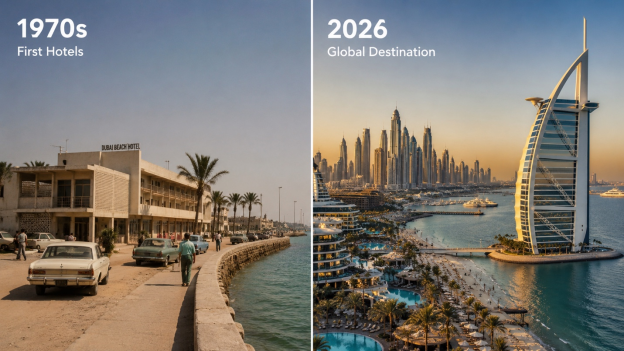
In the 1970s, the concept of Dubai as a tourist destination would have seemed faintly absurd to most people outside the Gulf. The emirate was not on any international traveller’s radar, and the idea of visiting Dubai for leisure rather than business or trade had simply not taken root. The handful of visitors who did arrive in this decade were overwhelmingly merchants, oil industry professionals, government contractors, and diplomats – people who came because their work required it, not because Dubai had placed itself on a list of must-see destinations. Tourism as an industry, in the modern sense of that word, did not yet exist in any meaningful form.
The accommodation options available in 1970s Dubai reflected this reality. The first proper hotel of note was the Carlton Tower, which opened in the early 1970s and offered a level of comfort that was considered reasonable by the standards of the day. The InterContinental Dubai, which opened in 1975 on the Deira waterfront overlooking the creek, represented a significant step forward – a proper international hotel brand bringing global hospitality standards to a city still finding its identity. A handful of smaller hotels and rest houses served the modest flow of business travellers, but the total number of hotel rooms across the entire emirate could be counted in the hundreds.
The visitor experience in 1970s Dubai was defined by simplicity and authenticity rather than luxury or engineered entertainment. Travellers who came could explore the creek, visit the gold and spice souks, observe traditional dhow building yards, and experience the genuine warmth of Emirati and expatriate hospitality in a city that had not yet learned to perform for outsiders. Restaurants were few and largely basic, nightlife was extremely limited, and the concept of tourist attractions – purpose-built experiences designed to entertain and impress – was virtually nonexistent. What Dubai offered instead was something raw, real, and unrepeatable: a window into a place in the midst of discovering itself.
The seeds of change were sown in the late 1970s and through the 1980s, as Dubai’s government began to recognise that tourism could become a significant economic pillar alongside trade and finance. The opening of the first five-star properties, including the Dubai Hilton and the Hyatt Regency, marked a conscious shift in strategy. The city was beginning to dress itself for international visitors, investing in infrastructure, hospitality training, and the brand-building that would eventually make Dubai one of the most recognised city names on Earth.
Now: Dubai as One of the World’s Top Tourist Destinations (2026)
In 2026, Dubai welcomes over 20 million international overnight visitors annually, consistently ranking among the top five most visited cities in the world. The transformation from a city with a few hundred hotel rooms in the 1970s to one that now offers over 140,000 hotel rooms across every category imaginable is one of the most remarkable stories in the history of global tourism. Dubai did not wait for tourists to discover it – it went out and invented itself as a destination, layering attraction upon attraction, experience upon experience, until the world had no choice but to take notice.
The hotel landscape in 2026 is extraordinary in its breadth and ambition. At the ultra-luxury end, the Burj Al Arab – opened in 1999 and immediately recognised as one of the most iconic hotel buildings ever constructed – set a global benchmark for hospitality that has since been pushed even higher by properties like Atlantis The Royal, the Four Seasons Resort Dubai, One and Only The Palm, and a constellation of other properties that compete to redefine what a hotel stay can feel like. Mid-range and budget travellers are equally well served by an extensive range of options that has grown dramatically over the past decade.
Dubai’s tourism proposition in 2026 is built on remarkable diversity. Theme parks including Dubai Parks and Resorts, IMG Worlds of Adventure, and Legoland Dubai cater to families. Desert safaris, hot air balloon rides, and camel experiences connect visitors to the emirate’s natural and cultural heritage. The opera house in Downtown Dubai, world-class art galleries, and a thriving live music scene serve culturally inclined travellers. Water sports, skydiving, and adventure activities draw thrill-seekers. And the sheer spectacle of the city itself – its skyline, its lights, its extraordinary built environment – functions as a destination in its own right.
From a city that barely registered on the global tourism map in the 1970s to one of the most visited and celebrated destinations on Earth in 2026, Dubai’s tourism story is ultimately a story about vision converting into reality at a pace the world had never seen before. Every visitor who arrives today stands in the shadow of a dream that was conceived when Dubai had almost nothing to show – and chose to build everything anyway.
Contributed by GuestPosts.biz