


Palm Jumeirah: Before Reclamation (2001) vs Luxury Island (2026)
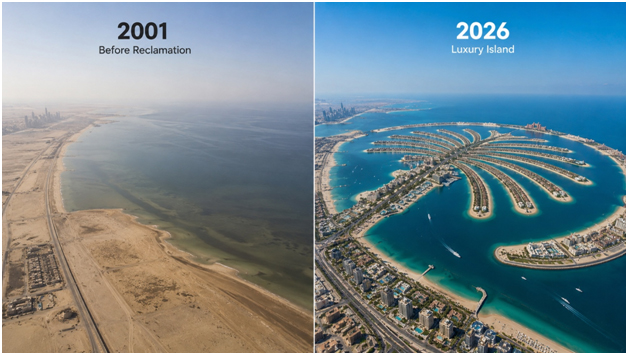
Then: Open Sea Before Reclamation (2001)
In the year 2000, if you had stood on the Jumeirah coastline and looked out across the Arabian Gulf, you would have seen nothing but open water stretching to the horizon. There was no island, no palm-shaped outline visible from space, no Atlantis hotel rising from the sea. The gulf waters off the coast of Jumeirah were calm, unremarkable, and entirely natural – a stretch of shallow Arabian Sea that had remained untouched since the beginning of recorded history. The idea that within just a few years, an entirely new landmass would be created here from nothing but sand and rock dredged from the seabed would have seemed, to most people, like science fiction.
The Palm Jumeirah project was announced in 1999 by Sheikh Mohammed bin Rashid Al Maktoum, and construction began in earnest in 2001. The engineering challenge was unlike anything that had been attempted before at this scale. The plan was to create an artificial island in the shape of a palm tree – a trunk, seventeen fronds, and a surrounding crescent breakwater – using approximately 94 million cubic metres of sand and 7 million tonnes of rock. No cement would be used; instead, the island would be built using a technique called rainbowing, in which sand was sprayed from ships and shaped by GPS-guided dredging equipment to within centimetres of accuracy.
In those early years of construction, the Palm Jumeirah was a spectacle of raw engineering. Thousands of workers, dozens of dredging vessels, and a fleet of GPS-guided machinery worked around the clock to build land from sea. The crescent breakwater – a seven-kilometre arc of rock that protects the entire island from wave action – was completed first, providing the shelter needed for the more delicate sand reclamation work to proceed within. Aerial photographs taken during this period show the island’s palm shape slowly emerging from the water like a geological event compressed into years rather than millennia.
The world watched in disbelief and fascination. Engineers, urban planners, and environmentalists debated whether the project was visionary or reckless. Concerns were raised about the impact on marine ecosystems, on coastal water circulation, and on the long-term stability of a man-made island built from loose sand in a seismically active region. Dubai acknowledged the challenges and pressed forward regardless, backed by the confidence of a government that had made a habit of doing what others said could not be done.
Now: Palm Jumeirah as a Global Luxury Landmark (2026)
In 2026, Palm Jumeirah is one of the most recognisable man-made structures on Earth, visible from space and instantly identifiable on any satellite map of the Arabian Gulf. What was open water just over two decades ago is now a thriving island community home to approximately 80,000 residents, hundreds of luxury villas and apartments, dozens of world-class hotels, and some of the most expensive real estate on the planet. The Palm Monorail connects the island to the mainland, and the Dubai Metro’s Route 2020 extension has further improved accessibility for the hundreds of thousands of visitors who come to the island every year.
At the crown of the Palm sits Atlantis The Palm, the iconic coral-pink resort hotel that opened in 2008 and instantly became one of Dubai’s most photographed landmarks. With its water park, marine habitats, celebrity restaurants, and underwater suites, Atlantis set the tone for the kind of ultra-luxury, experience-driven hospitality that Palm Jumeirah would come to represent. In 2023, a second Atlantis property – Atlantis The Royal – opened on the crescent, raising the bar even further with its extraordinary architecture, rooftop infinity pools, and constellation of Michelin-starred dining concepts.
Property on the Palm Jumeirah in 2026 ranks among the most sought-after in the entire Middle East. Signature villas on the fronds, with their private beaches and direct sea access, regularly transact at prices that place them among the most expensive residential properties in the world. The island has attracted a global community of ultra-high-net-worth residents, celebrities, and business leaders who are drawn by the combination of privacy, luxury, lifestyle, and the extraordinary novelty of living on a man-made island shaped like a palm tree in the Arabian Gulf.
From open sea in 2001 to a globally iconic luxury island in 2026, Palm Jumeirah is the most dramatic land creation story in modern history. It did not evolve – it was willed into existence by a government and a people who refused to accept that geography was a fixed constraint. In doing so, Dubai did not just build an island. It built a symbol of what becomes possible when ambition is given the freedom to reshape the physical world itself.
Contributed by GuestPosts.biz