



UAE Passport: From Restricted Travel (1971) to Top 5 in the World (2026)
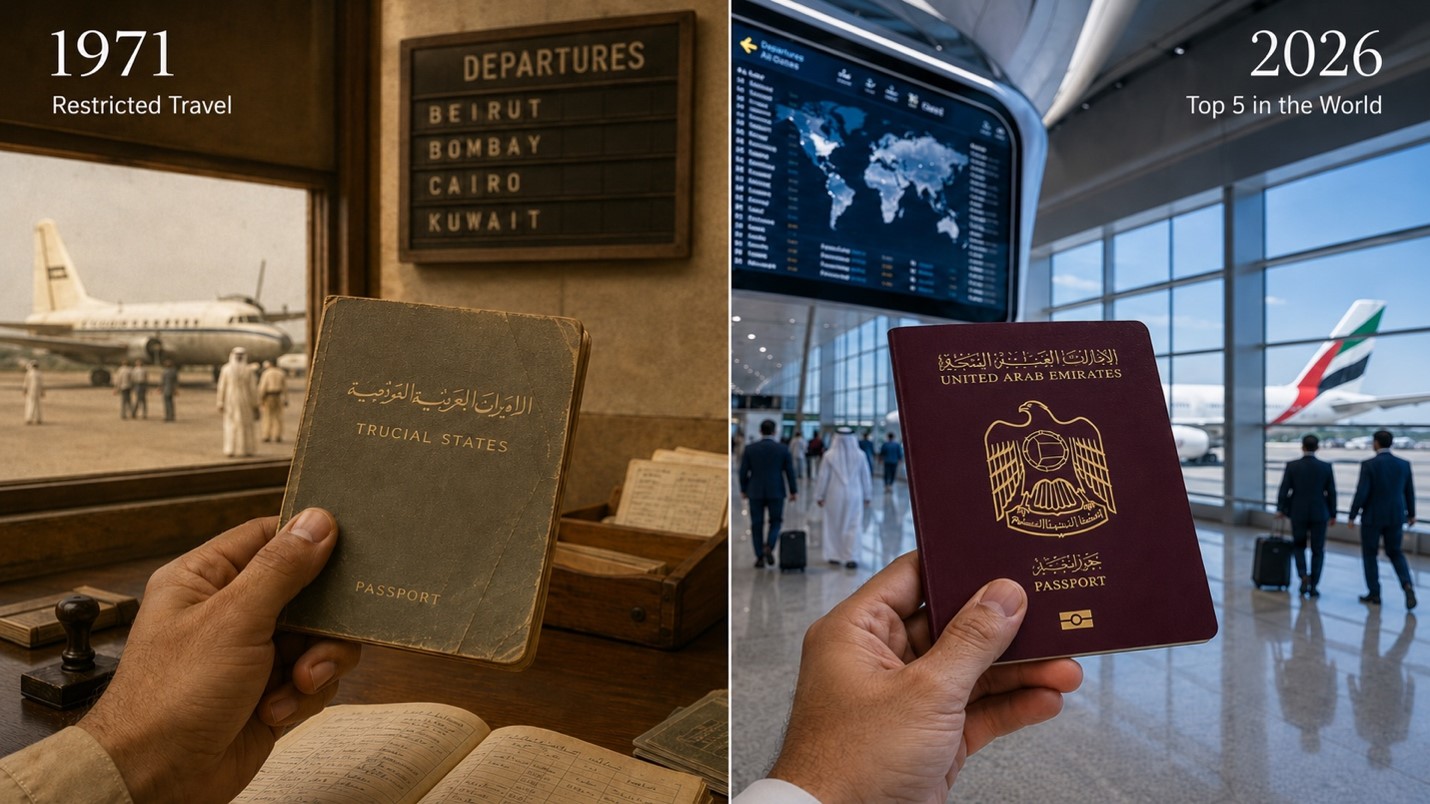
Then: A Brand-New Passport With Almost Nowhere to Go
When the United Arab Emirates came into existence on 2 December 1971, the newly issued UAE passport was, by any international measure, one of the weakest travel documents in the world. This was not a matter of diplomatic hostility or political controversy – the young nation had not made enemies and held no particular stigma in the eyes of the international community. The weakness of the passport was simply the natural condition of a brand-new country with no established network of bilateral travel agreements, no significant diplomatic presence in most of the world’s capitals, and no track record of international engagement upon which visa-free access could be negotiated. The UAE in 1971 was unknown to most immigration officers and most governments across the globe, and the practical consequence of that anonymity was a passport that opened very few doors.
A UAE national hoping to travel internationally in those early years of statehood faced a bureaucratic obstacle course that would be entirely unrecognisable to a UAE passport holder today. Travelling to Europe meant applying for visas at individual embassies, submitting bank statements, letters of employment, and detailed travel itineraries, waiting weeks for a decision, and accepting that rejection was always a possibility regardless of the purpose of the trip. Travel to the United States required a full visa application process with an in-person consular interview. Even many countries in Asia and Africa that are today freely accessible to UAE nationals required advance visa arrangements that made spontaneous travel essentially impossible. The passport certified your citizenship and your identity, but it provided almost no practical freedom of international movement beyond the immediate Gulf region.
The geopolitical context of the early 1970s compounded these challenges. The world was still deeply divided along Cold War lines, and many Western nations maintained blanket visa requirements for all nationals from the Middle East and the developing world as a matter of routine immigration policy, without any particular assessment of individual countries. A UAE national carrying a freshly minted passport in 1971 or 1975 could access perhaps thirty countries without requiring a visa arranged in advance – a figure that placed the UAE passport alongside the weakest travel documents in the world at that time. The contrast with what that same passport would become five decades later is almost impossible to overstate.
Through the 1970s and into the 1980s, as the UAE began to build its international diplomatic presence, establish embassies and consulates around the world, and develop the economic credentials that would eventually give it leverage in bilateral negotiations, the passport’s power began to grow slowly. The establishment of the Gulf Cooperation Council in 1981 created a framework for freedom of movement between Gulf states that gave UAE nationals easier access to Saudi Arabia, Kuwait, Bahrain, Qatar, and Oman. A handful of bilateral visa waiver agreements were signed with friendly nations. But progress was measured in years and individual agreements rather than in the sweeping expansions of access that would come later. In the early 1980s, a UAE passport holder could reach perhaps forty countries without advance visa arrangements – an improvement, but still a fraction of what the future held.
Now: The UAE Passport Among the Most Powerful on Earth (2026)
In 2026, the UAE passport is consistently ranked within the top five most powerful travel documents in the world by every major passport ranking authority, including the Henley Passport Index, the Arton Capital Passport Index, and the Global Passport Power Rank. UAE nationals can access over 180 countries and territories across every inhabited continent without requiring a visa arranged in advance – either entering entirely visa-free or obtaining a visa on arrival upon reaching their destination. This figure means that a UAE passport holder in 2026 can, in practical terms, board a flight to almost anywhere in the world on a moment’s notice without the advance bureaucratic preparation that was once an inescapable part of international travel for the citizens of this nation.
The scale of this transformation is difficult to fully absorb. In just over fifty years, the UAE passport has gone from granting access to roughly thirty countries to granting access to more than 180. That journey – from the bottom tier of global passport power to the very summit – represents one of the most dramatic improvements in travel document strength ever recorded for any nation in a comparable timeframe. Countries that once required UAE nationals to present visa applications, bank statements, and sponsorship letters now welcome them through dedicated e-gate immigration lanes with nothing more than a biometric scan. The world has not merely opened to UAE passport holders. It has rolled out a red carpet.
The geographic reach of that access in 2026 covers virtually the entire world in a meaningful way. All twenty-six countries of the European Schengen Zone are freely accessible, allowing UAE nationals to travel across Europe from Portugal to Poland without a single border formality beyond showing their passport. The United Kingdom grants visa-free entry for stays of up to six months. The United States, which once required UAE nationals to undergo full consular visa interviews, now admits them under the Electronic System for Travel Authorisation, the same streamlined process used by citizens of Western European nations. Japan, South Korea, Singapore, Australia, Canada, Brazil, Argentina, and dozens of other nations that were once firmly behind visa walls are now fully accessible.
The diplomatic achievement that underpins this passport power is immense and often underappreciated. Every visa-free agreement represents months or years of careful negotiation by the UAE Ministry of Foreign Affairs, using the country’s economic weight, its reputation as a stable and trustworthy international partner, its position as a global aviation hub, and the impeccable track record of its citizens as visitors abroad. Countries grant visa-free access when they trust the issuing nation – its institutions, its economy, its ability to manage the return of its own citizens, and the character of the people who carry its passport. The UAE has earned that trust through five decades of principled international engagement, generous humanitarian contributions, and a foreign policy built on neutrality, dialogue, and mutual respect.
For UAE nationals themselves, the strength of the passport is one of the most personal and tangible expressions of their country’s rise. It represents freedom – the freedom to explore, to conduct business, to study, and to experience the world without the bureaucratic friction that constrains the citizens of most nations. A generation of Emiratis has grown up with a passport that takes them to Tokyo for a weekend, to Paris for a fashion show, to New York for a business meeting, and back home to Dubai within days, with no visa offices, no waiting periods, and no uncertainty about whether they will be admitted. That freedom was built, negotiated, and earned over fifty years of extraordinary nation-building – and it stands today as one of the most powerful symbols of how completely and how magnificently the UAE has transformed itself since the day it first issued a passport to its people in 1971.
Contributed by GuestPosts.biz