


Dubai Smart City: Paper Government (1990s) vs AI-Powered City (2026)
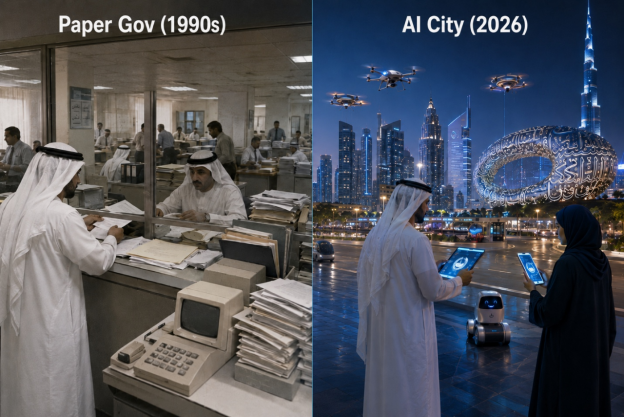
Then: Paper-Based Government and Manual Services in the 1990s
As recently as the 1990s, interacting with the Dubai government meant navigating a world of paper forms, physical queues, rubber stamps, and manual processing systems that would be almost unrecognisable to a resident of the emirate today. Applying for a trade licence, renewing a visa, registering a vehicle, or obtaining a birth certificate required in-person visits to the relevant government department, often multiple times as documents were reviewed, queried, returned for correction, and resubmitted. Processing times were measured in days and weeks rather than the minutes that residents now take for granted, and the outcome was never entirely predictable.
Government offices in this era operated on fixed hours, were often crowded, and required applicants to bring original documents along with multiple photocopies that would be manually filed in paper archives. Record-keeping was entirely analogue, with files stored in physical folders that had to be retrieved, reviewed, and re-filed by hand. Communication between different government departments was slow, often relying on internal memos and telephone calls rather than any form of integrated digital system. The result was a level of bureaucratic friction that, while not unusual by international standards of the time, created real costs in time and productivity for residents and businesses alike.
For businesses operating in Dubai in the 1990s, the administrative burden was considerable. Company formation required engagement with multiple authorities in sequence, each with its own paperwork requirements and processing timelines. Customs documentation for the emirate’s vast trading operations was handled through paper manifests and manual entry. Banking transactions that today happen instantly across digital platforms required physical visits to bank branches and the manual completion of transfer forms. The city was growing at remarkable speed, but the administrative infrastructure supporting that growth was still largely rooted in analogue systems inherited from an earlier era.
The seeds of change were planted in the late 1990s as Dubai’s leadership began to articulate a vision for e-government that would use emerging internet technology to transform the relationship between citizens and the state. The establishment of Dubai Internet City in 2000 was part of this broader vision, creating the technology infrastructure and talent base that would eventually power the smart city transformation. But in those early years, the digital revolution in government services was still a blueprint rather than a reality.
Now: Dubai as a Global Smart City Leader (2026)
In 2026, Dubai is consistently ranked among the top smart cities in the world, a transformation so complete that the paper-based government of the 1990s feels like a different civilisation entirely. The Dubai government has set an explicit target of providing 100% of its services digitally, and it has come extraordinarily close to achieving that goal. Residents and businesses can access virtually every government service through the Dubai Now app or the DubaiConnect platform – a single integrated digital interface that consolidates services from dozens of government entities into one seamless experience available 24 hours a day, seven days a week, from any device anywhere in the world.
Artificial intelligence is now embedded throughout the machinery of Dubai’s government operations. The Dubai AI Roadmap, launched as part of the broader UAE National AI Strategy, has driven the deployment of AI across areas including public safety, traffic management, healthcare administration, judicial processes, and urban planning. The Dubai Police smart command centre uses AI-powered analytics to monitor the city in real time. The Roads and Transport Authority uses predictive AI to optimise traffic signal timing across thousands of intersections simultaneously. The Dubai Health Authority uses AI to manage hospital capacity and patient flow across the public health system.
The paperless government vision extends to areas that were once considered impossible to fully digitise. Court proceedings can now be initiated, documented, and resolved entirely online through the Dubai Courts digital platform. Business licences are issued within minutes through automated systems that verify documentation, conduct compliance checks, and generate official certificates without any human intervention for the vast majority of standard applications. The Dubai Land Department processes real estate transactions through a blockchain-based system that provides an immutable, instantly verifiable record of every property transfer in the emirate.
From paper forms and rubber stamps in the 1990s to a fully AI-integrated smart city government in 2026, Dubai has accomplished in three decades what most cities spend a century attempting. The transformation is not merely technological – it represents a fundamental reimagining of the relationship between a government and its people, built on the principle that every interaction should be faster, simpler, more transparent, and more responsive than the one before. In Dubai, the smart city is not a future aspiration. It is the present reality, and it is still accelerating.
Contributed by GuestPosts.biz