


Dubai Work Culture: Sunrise to Sunset Labour Then vs the Flexible Four-Day Week (2026)
Then: A Working Culture Shaped by Necessity and Endurance
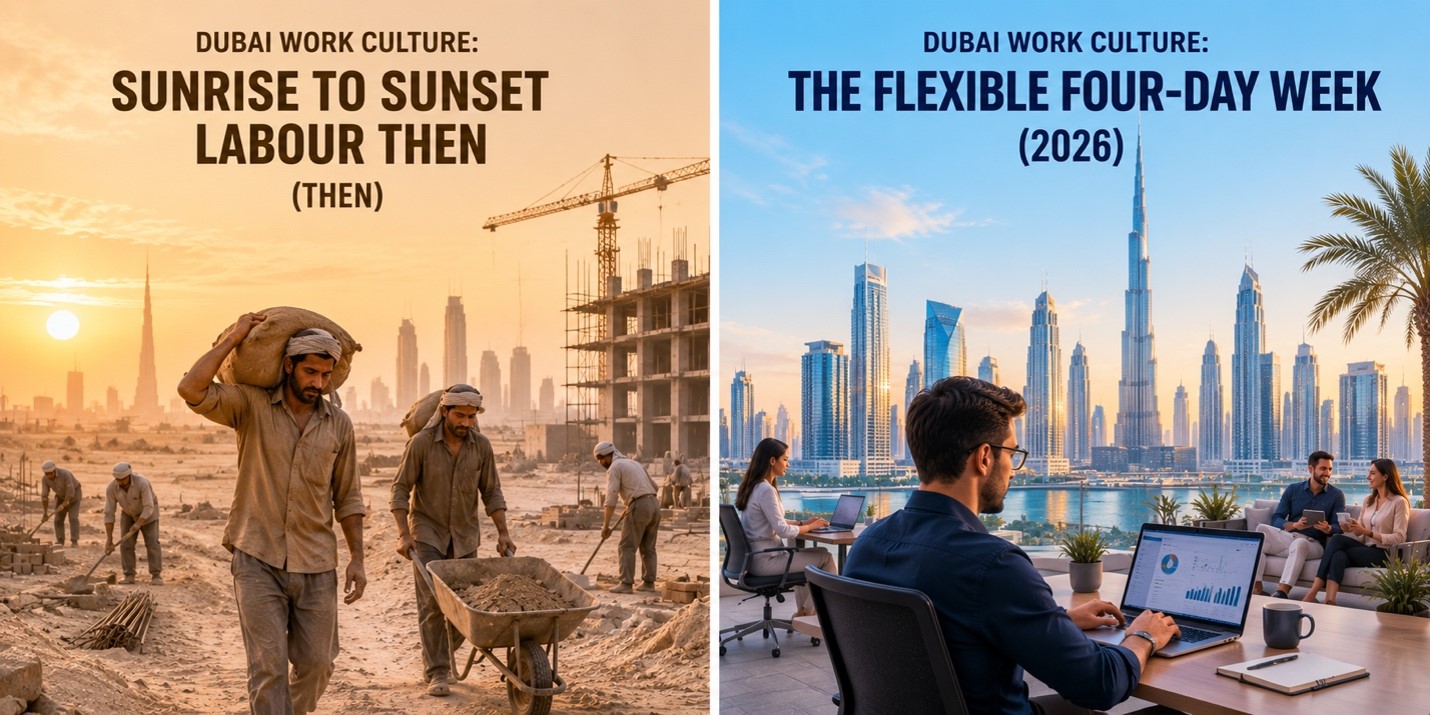
In the decades before Dubai became the global city it is today, work was not something that came with boundaries, policies, or flexible arrangements. It was a matter of survival, and the culture that surrounded it reflected that reality with complete honesty. Fishermen rose before dawn and were on the water while the city was still dark. Pearl divers spent entire summers at sea under conditions of extraordinary physical hardship, diving repeatedly from sunrise to sunset in waters where the pressure, the heat, and the exhaustion combined to make each season a genuine test of the human body. Traders in the souk opened their shutters at first light and kept them open until there was no one left on the street to buy. The working day had no fixed end because the work itself had no fixed boundaries – it continued for as long as the light lasted and sometimes well beyond it.
The concept of work-life balance was not part of the vocabulary of old Dubai, not because people were cruel or indifferent to human welfare but because the economic reality of a pre-oil trading settlement left little room for it. Every hour of work was an hour of income, and income was the difference between security and vulnerability in a world without the social safety nets that more developed economies had built around their workers. Saturday and Sunday were not guaranteed days of rest. Annual leave was not a legally mandated entitlement enforced by labour tribunals. Work stopped when the job was done, when the season ended, or when physical exhaustion made it impossible to continue. The rhythm of labour was dictated entirely by the demands of the economy and the environment.
Even as Dubai modernised through the 1970s and 1980s and a formal employment sector emerged alongside the oil-driven economy, the working culture retained much of its demanding character. The standard working week in the UAE was six days. Hours were long across most sectors. The construction industry that was building Dubai’s extraordinary physical transformation operated around the clock in shifts, with workers often labouring through the intense summer heat in conditions that would not be tolerated in more regulated employment environments. The ambition that drove the city’s growth was matched by an expectation of effort from every person contributing to it, and the line between dedication and overwork was rarely examined with much critical attention.
Now: Dubai Introduces the Four-Day Summer Working Week (2026)
On the twenty-ninth of June 2026, the Dubai Government Human Resources Department implemented the third successive edition of the Our Flexible Summer programme, introducing a reduced working schedule for public sector employees that represents one of the most progressive workplace initiatives in the history of the emirate. Under the programme, which runs until the tenth of September 2026, government entities in Dubai operate under two flexible working models that give employees significantly greater control over how they structure their working hours during the hottest and most challenging months of the year. The initiative is not merely a summer convenience. It is a statement about the kind of employer Dubai intends to be and the kind of city it intends to become – one that treats the wellbeing of its workforce not as a cost to be minimised but as an investment to be made.
The flexible summer arrangement builds on a broader transformation of working culture in Dubai that has accelerated dramatically over the past several years. The UAE made international headlines in January 2022 when it became one of the first countries in the world to officially shift its national working week to Monday through Friday, abandoning the Sunday through Thursday model that had defined working life in the Gulf for generations. The change aligned the UAE with global business hours, making it easier for international companies to conduct real-time business across time zones and signalling that the country was willing to reshape its social calendar to compete at the highest level of the global economy. For hundreds of thousands of workers in Dubai, the change meant that for the first time, their weekends coincided with those of their families and friends in Europe, the Americas, and most of Asia.
The workplace transformation extends well beyond working hours. Remote work policies that were accelerated by necessity during the pandemic years have been retained and formalised across many sectors, with Dubai positioning itself as a city where talented global professionals can work from anywhere while enjoying the lifestyle, infrastructure, and opportunities the emirate provides. The Dubai Digital Nomad Visa, which allows remote workers to live in Dubai for up to a year while employed by companies abroad, has attracted thousands of high-earning professionals from around the world and generated significant economic activity for the hospitality, real estate, and retail sectors. The message is clear and deliberate – Dubai wants the best people in the world, and it is willing to offer working conditions competitive with any city on Earth to attract and retain them.
From dawn-to-dusk labour without boundaries or entitlements in the pre-modern era to a four-day summer working week, flexible arrangements, and a global nomad visa that welcomes remote workers from every corner of the planet, Dubai’s evolution as a place to work reflects the same pattern as every other dimension of its story. The city began with what it had, built what it needed, and is now setting standards that the rest of the world increasingly looks to as a model for what enlightened, ambitious, human-centred employment culture can achieve when it is treated as seriously as any other form of infrastructure.
Contributed by GuestPosts.biz