


Dubai and Plastic: From a Throwaway Culture to a Zero-Waste Vision (2026)
Then: When Single-Use Plastic Was Simply Part of Life
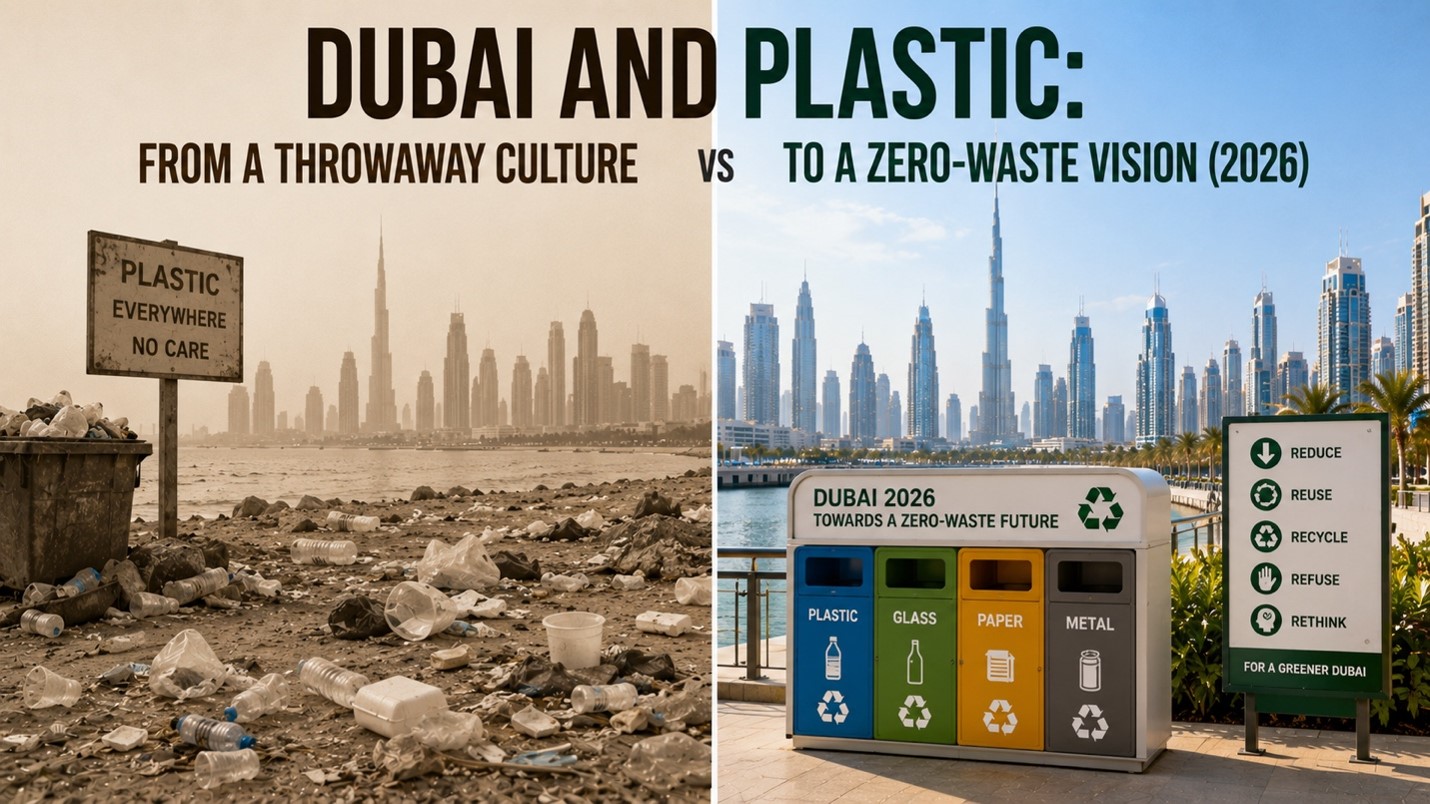
There was a time in Dubai’s recent history when the question of how something was packaged, disposed of, or recycled was barely a question at all. Plastic bags were handed out at supermarket checkouts without a second thought, in quantities that bore no rational relationship to the number of items purchased. Every takeaway meal arrived in a fortress of single-use containers, wrapped in cling film, sealed with plastic cutlery and napkins in separate plastic packaging, and delivered in a plastic bag tied at the top with another piece of plastic. Coffee came in polystyrene cups. Water came in plastic bottles bought by the crate. Street food was served on disposable plastic plates with disposable plastic forks. The city consumed plastic with the casual abundance of a place that had never been asked to think about where any of it went afterward.
This was not a uniquely Dubai problem – it was a global one, and Dubai was simply participating in the culture of disposability that the twentieth century had normalised everywhere. But certain features of Dubai’s development made the plastic challenge particularly acute. The city’s extraordinary growth rate meant that its population, and therefore its consumption, was expanding faster than almost any other urban environment on Earth. The culture of convenience that drove Dubai’s retail, hospitality, and food and beverage sectors created a demand for single-use packaging that was almost insatiable. And the hot desert climate, which made carrying reusable bottles and bags less practical than in cooler environments, added an additional layer of cultural resistance to change that environmental advocates in the city found genuinely difficult to overcome.
For years, plastic waste was simply part of the visual landscape of a rapidly developing city. Construction sites generated it in vast quantities. Markets produced it daily. Beaches and waterways accumulated it gradually despite periodic clean-up campaigns. The Arabian Gulf, one of the most biodiverse and ecologically significant bodies of water in the world, received more than its share of the plastic that slipped through the gaps in collection and disposal systems that were always struggling to keep pace with a city growing faster than its waste management infrastructure could follow. Acknowledging this reality honestly is not a criticism of Dubai – it is an acknowledgement of where the city, like most cities, started before the environmental reckoning arrived.
Now: Dubai’s Multi-Phase Plastic Ban Reshapes an Entire Consumer Culture (2026)
The shift began in earnest with the UAE’s landmark decision to phase out single-use plastics through a structured, multi-stage ban that gave businesses and consumers time to adapt while making the direction of travel unambiguously clear. The programme, overseen by the UAE Ministry of Climate Change and Environment, was designed not as a single announcement but as a rolling series of prohibitions that progressively removed the most harmful single-use plastic products from circulation across the country. Each phase built on the last, creating a momentum of change that gradually reshaped consumer habits, retail operations, food service businesses, and supply chains across the entire economy.
By 2026, the plastic ban has reached its third and most comprehensive phase, covering a category of products that touch virtually every aspect of daily consumer life. Plastic plates, plastic food containers, plastic tableware of all kinds, and beverage cups with plastic lids have been removed from the market across Dubai and the wider UAE. The effect on the visual experience of eating and drinking in the city has been dramatic and surprisingly rapid. Where takeaway meals once arrived in towers of single-use plastic, they now come in compostable containers made from sugarcane pulp, recycled cardboard, and other sustainable materials. Coffee shops that once served hundreds of drinks a day in polystyrene cups have redesigned their entire service model around reusable options and sustainable alternatives, often discovering in the process that customers respond positively to the change and the story it allows the business to tell about its values.
The sustainability transformation extends well beyond the plastic ban. Dubai Electricity and Water Authority, known as DEWA, has in 2026 ranked first globally in thirteen key performance indicators across its operations, including recording the world’s lowest customer minutes lost per year – a measure of grid reliability that reflects the extraordinary quality of the utility infrastructure serving the city. DEWA’s push toward clean energy, anchored by the Mohammed bin Rashid Al Maktoum Solar Park which is on track to become the largest single-site solar facility in the world with a planned capacity of five thousand megawatts, is steadily shifting Dubai’s energy profile away from fossil fuel dependence toward a renewable future that was entirely inconceivable when the city ran on diesel generators in the 1960s.
From a throwaway culture of unlimited plastic convenience that seemed entirely natural to anyone living through the peak years of Dubai’s growth, to a city in 2026 with enforceable plastic bans, world-leading utility sustainability metrics, and an ambition to decarbonise its entire economy by 2050, Dubai’s environmental journey is a story about a city that looked honestly at what it had become and decided to become something better. That kind of self-examination, combined with the executive will to act on its conclusions at pace and at scale, is perhaps the most quietly impressive thing Dubai has done in a history already full of impressive things.
Contributed by GuestPosts.biz