


Dubai Transportation: Camel Tracks vs Dubai Metro (2026)
Then: How Dubai Used to Move
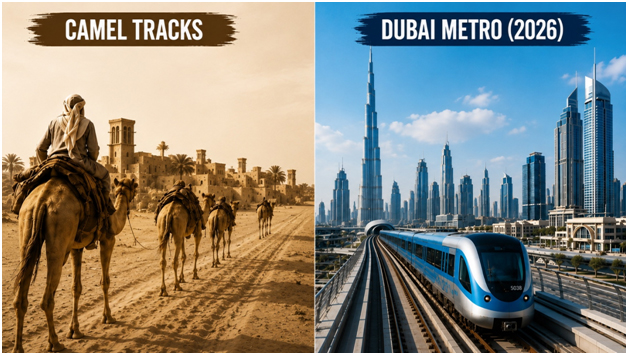
Before Dubai became a city of gleaming highways and driverless metro trains, movement across its landscape was dictated by nature and necessity. For centuries, the camel was the most reliable form of overland transport across the Arabian Peninsula, including the stretches of desert that would one day become the streets of modern Dubai. Camel caravans linked inland settlements, carried trade goods, and allowed Bedouin communities to navigate the harsh terrain with a level of endurance that no wheeled vehicle of the era could match. Camel tracks – worn paths through the sand – were the roads of their time, winding between oases, settlements, and coastal trading posts.
Along Dubai Creek, the abra – a small traditional wooden water taxi – was the primary mode of crossing between the Deira and Bur Dubai sides of the city. For a few fils, residents and traders could cross the creek in minutes, and this simple service was the lifeblood of commercial movement in old Dubai. Abras were not just transportation; they were a social institution, a daily ritual that connected two halves of a growing trading town. Even today, abras still operate on the creek as a nod to heritage, though they are now surrounded by a completely transformed waterfront.
When motor vehicles began arriving in Dubai in the 1950s and 1960s, the roads were few and largely unpaved. The first tarmac roads only appeared in the 1960s, and even by the mid-1970s, the road network was basic by any modern standard. Shared taxis and privately owned vehicles were the dominant forms of motorised transport. There were no traffic signals in some parts of the city, no multi-lane highways, and certainly no public rail system of any kind. Getting from one end of Dubai to the other was a slow, dusty, and sometimes unreliable affair.
Buses existed in a rudimentary form, but schedules were irregular and coverage was limited. The concept of an integrated public transportation network – one that could move hundreds of thousands of people efficiently across a sprawling modern city – was completely absent. Dubai’s transport story in those early decades was one of improvisation, community reliance, and gradual adaptation to a world that was changing faster than its infrastructure could keep up.
Now: Dubai’s World-Class Transport Network in 2026
In 2026, Dubai operates one of the most advanced urban transportation networks in the world. At the heart of this system is the Dubai Metro, which opened its Red Line in September 2009 and has since expanded into a fully automated, driverless rail network that serves millions of passengers every month. The metro runs entirely without human drivers, controlled by sophisticated software systems that manage speed, doors, scheduling, and safety in real time. Its sleek, air-conditioned carriages are a world away from the dusty tracks and wooden abras of generations past.
The Dubai Metro network in 2026 spans both the Red Line and the Green Line, covering key districts including Deira, Bur Dubai, Downtown Dubai, Dubai Marina, and Dubai International Airport. The Route 2020 extension, completed ahead of Expo 2020, further connected the network to the Al Maktoum International Airport corridor and the Expo City district. Plans for additional lines and extensions continue to be developed, with future routes targeting areas of rapid residential and commercial growth across the emirate.
Beyond the metro, Dubai’s transport ecosystem includes the Dubai Tram, an extensive air-conditioned bus network, water buses along the creek and marina, ride-hailing platforms, and a rapidly expanding fleet of electric vehicles supported by government-backed charging infrastructure. The Roads and Transport Authority manages all of this under a unified framework, with smart ticketing via the Nol card allowing seamless travel across multiple transport modes with a single payment system.
Perhaps most symbolically, the camel – once the king of Arabian transport – now appears in Dubai primarily at heritage festivals, racing tracks, and tourist experiences designed to preserve cultural memory. The journey from camel track to driverless metro is not just a story of technological progress. It is a testament to how completely and how quickly Dubai reimagined what a city could be, building from the ground up a transport future that the rest of the world is still working to achieve.
Contributed by GuestPosts.biz