


The Map of Dubai: Then vs Now – A City That Rewrote Its Own Geography
Then: What the Old Map of Dubai Showed
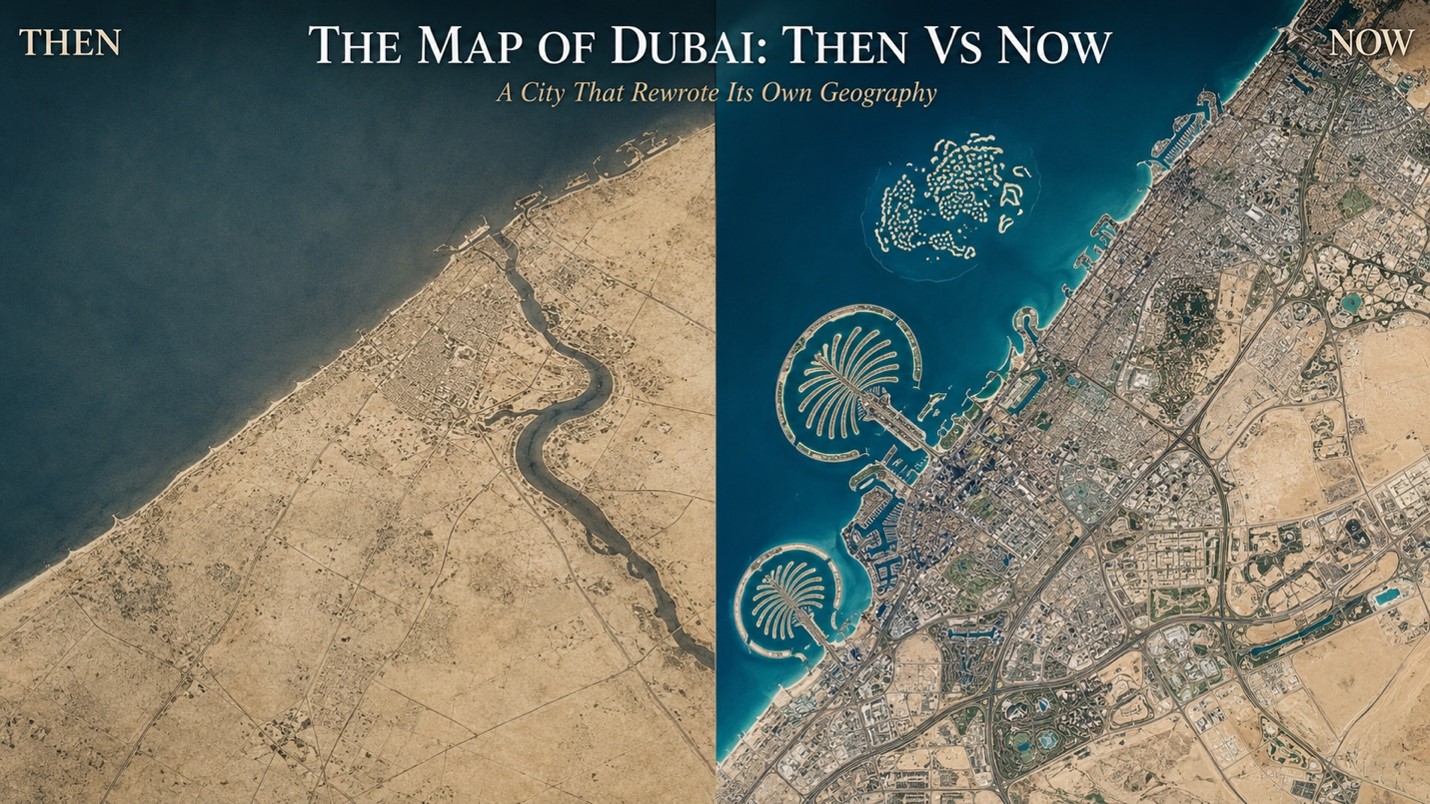
If you were to find an old map of Dubai from the 1950s or early 1960s and lay it flat on a table, you would be looking at something that bears almost no resemblance to any modern representation of the city. The map would be almost entirely blank. A thin coastline running along the top edge where the Arabian Gulf meets the land. A narrow inlet of water cutting inland from that coast – the natural creek that had served as a harbour for trading boats for generations. Two small smudges of settlement on either side of that inlet, representing the modest clusters of homes, shops, and trading houses that made up the sum total of what Dubai was. And beyond those two settlements, in every direction the map could reach, nothing. No roads pushing southward. No districts spreading east or west. No infrastructure of any kind marked on the paper. Just the vast, featureless, unapologetic blankness of the Arabian desert stretching to every edge of the page.
Those early maps of Dubai were honest documents. They showed exactly what existed and nothing more. The total land area that could genuinely be described as urban Dubai in the mid-twentieth century was so small that it would fit comfortably inside a single modern district of the city as it exists today. Cartographers of the era had no reason to give Dubai more than a footnote on regional maps of the Arabian Peninsula. It was a minor port town of modest regional significance, noteworthy mainly to the merchants and sailors who used its natural harbour as a waypoint on longer trading journeys. The surrounding desert was not merely undeveloped – it was unmarked, unnamed, and utterly indifferent to the existence of the small human settlement pressed against the coast.
If you traced the boundaries of Dubai on that old map with your finger, the exercise would take only seconds. The inhabited area was so compact that the entire community could gather in a single open space. There were no suburbs because the city had no centre large enough to require them. There were no satellite towns, no industrial zones, no airport districts, no waterfront developments. Roads, where they existed at all, were unpaved tracks that petered out into open sand within a few hundred metres of the last building. The map told you, in the clearest possible visual terms, that this was a place at the beginning of its story. What it could not tell you – what no map of that era could have possibly communicated – was how extraordinary that story was about to become.
Even as recently as the 1970s, when oil revenues had begun to flow and the first phase of Dubai’s modernisation was underway, updated maps of the city still showed a settlement that was modest by any international standard. New roads had been laid. A proper airport had been built. Port facilities had been expanded and formalised. Government buildings and hospitals and schools had appeared. But the overall footprint of the city remained relatively contained, its growth measured in single-digit kilometres rather than the tens of kilometres that would define the expansions to come. A traveller of the 1970s looking at a map of Dubai and imagining what it might become in fifty years would have needed an almost supernatural capacity for optimism to predict anything close to the reality that 2026 would deliver.
Now: What the New Map of Dubai Reveals
Place the old map of Dubai beside a current satellite map of the city and the visual shock is immediate and total. The new map is full. Overwhelmingly, almost aggressively full. Where the old map showed two small settlements and vast emptiness, the new map shows an unbroken carpet of urban development spreading in every direction from the original coastal settlement, pushing south along the coastline for more than forty kilometres, spreading inland into what was pure desert, reaching northward, eastward, and in the case of the extraordinary man-made islands visible from space, literally outward into the sea itself. The Arabian Gulf, which on the old map formed a clean, uninterrupted natural boundary along the city’s northern and western edge, now shows the unmistakable outlines of land that did not exist in nature – palm-shaped islands, crescent breakwaters, and artificial peninsulas that add entirely new coastline to a city that decided its natural geography was insufficient for its ambitions.
The scale of what the new map reveals is genuinely difficult for the human mind to process without a reference point. Dubai today covers approximately 4,114 square kilometres of territory. In the 1960s, the developed urban area covered perhaps three to four square kilometres. That means the city has expanded its footprint by a factor of more than one thousand in the space of roughly six decades. If you were to superimpose the entire old Dubai – every building, every street, every structure that existed in the city of the 1950s – onto the map of modern Dubai, it would disappear like a postage stamp pressed onto a football field. It would be invisible. Lost. Swallowed entirely by the scale of what has been built around it and beyond it and on top of it. That is the arithmetic of Dubai’s growth, and no arithmetic has ever been more staggering in the context of urban development.
The new map tells the story of a city that grew not in one direction but in all directions simultaneously, driven by a vision that was never constrained by the logic of incremental expansion. New districts did not grow organically from the edges of existing ones. They were planned, announced, funded, and built as complete new urban environments – entire communities with their own road networks, their own utilities, their own commercial centres and green spaces and schools – that appeared on the map fully formed where there had been nothing the year before. The map of Dubai grew in leaps and bounds rather than in steps, each leap representing a master-planned development of an ambition and a scale that would be considered remarkable anywhere else in the world but that in Dubai became almost routine.
What the new map also reveals, to anyone who looks carefully, is the extraordinary diversity of what has been built across this expanded geography. The coastline that stretches along the western edge of the map is now lined with towers and resorts and marinas and promenades. The inland areas show a different texture – residential communities with curved streets and green parks and golf courses carved out of territory that was bare sand within living memory. Industrial and logistics zones appear on the map’s southern reaches, feeding the ports and free zones that power Dubai’s role as a global trading hub. Technology and media campuses cluster along the main arterial corridors. Healthcare and education districts occupy their own carefully planned zones. Financial districts of glass and steel rise at the city’s commercial core. Every category of human activity that a modern city requires has been assigned its space on the map, planned with a deliberateness and a generosity of scale that speaks to a city designed not for what it was but for what it intended to become.
Perhaps the most humbling thing about comparing the old map of Dubai to the new one is the realisation of how much of the new city was built on pure belief. When planners drew the first expansions of Dubai’s boundaries on paper in the 1970s and 1980s, the land they were marking was empty desert. There were no residents waiting to move in. There were no businesses waiting to open. There was no organic demand pressing against the city’s edges and demanding new space. The expansion was driven entirely by a conviction – held by the city’s rulers and eventually shared by millions of people from around the world who chose to make Dubai their home – that if you built it, they would come. History has validated that conviction more completely than even its most optimistic original holders could have dared to hope. The old map showed what Dubai was. The new map shows what believing in a city, completely and without reservation, can make it become.
Contributed by GuestPosts.biz