


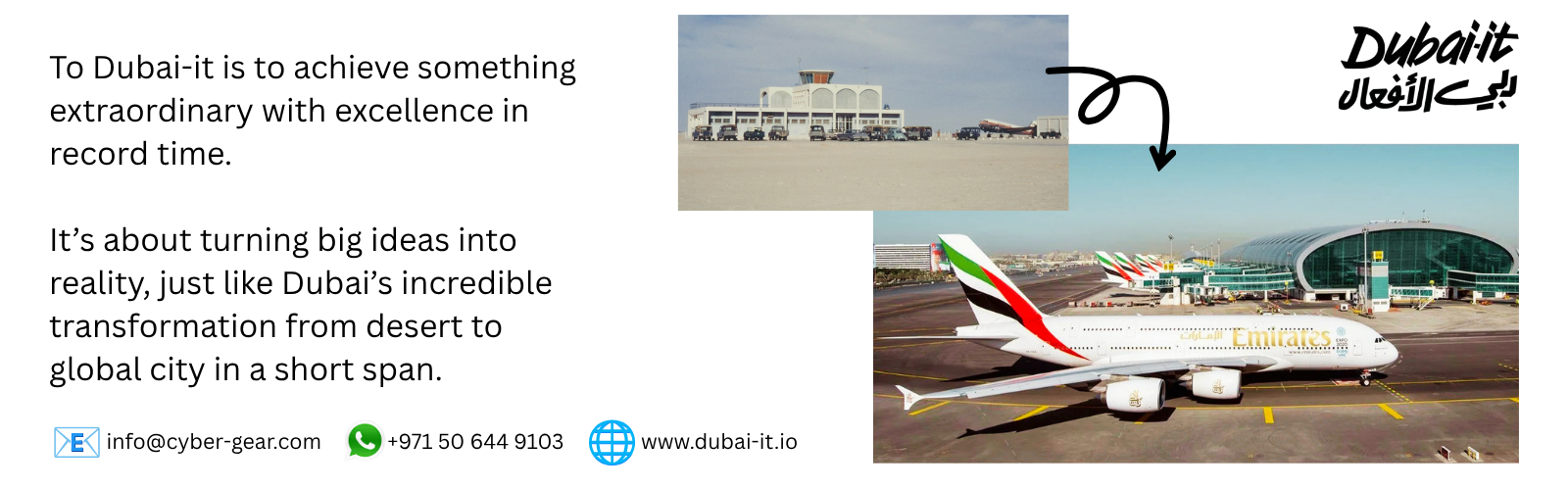
Dubai Airport: 1960s Airstrip vs World’s Busiest Hub (2026)
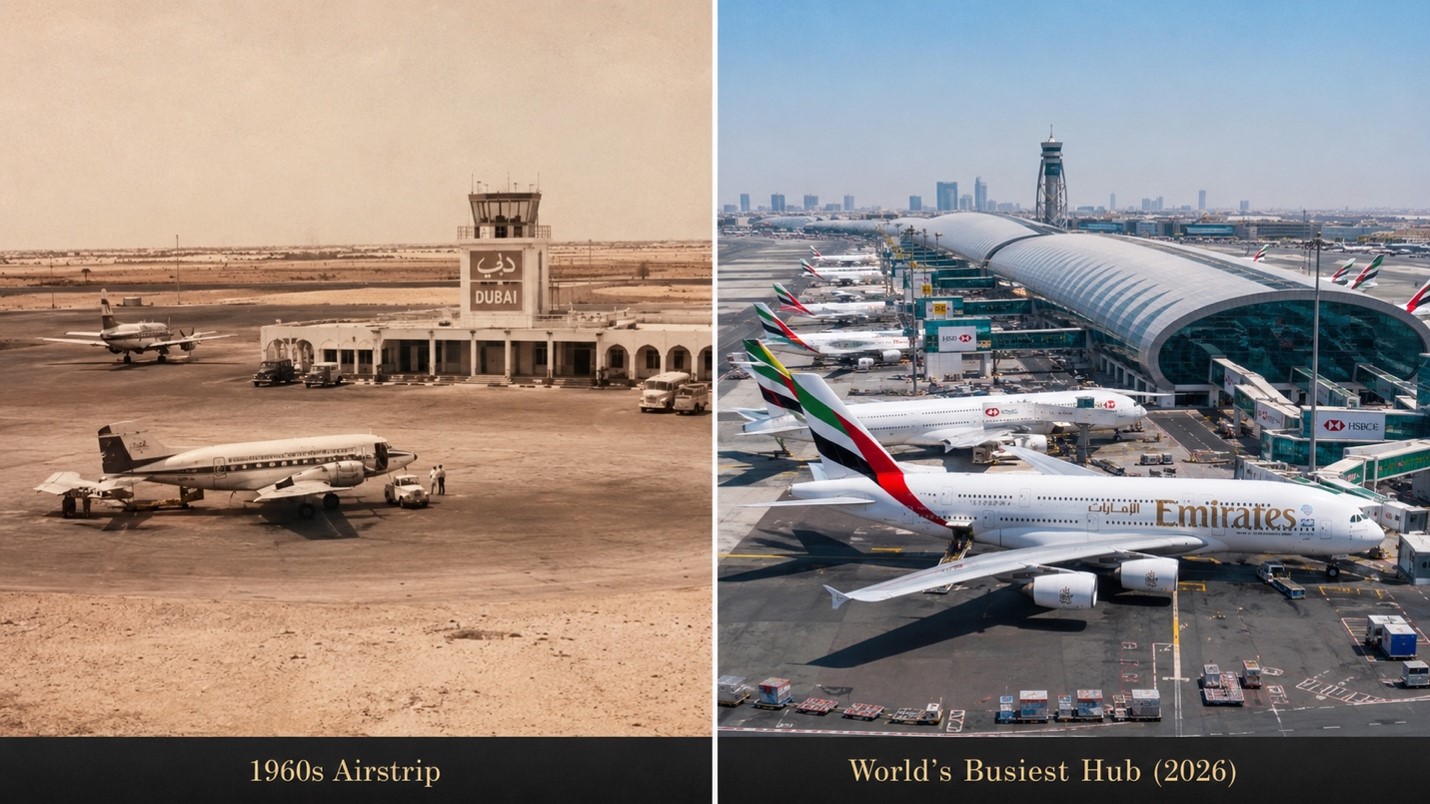
Then: Dubai’s Humble Airstrip in the 1960s
In 1959, Dubai opened its very first airport – a simple sand and gravel airstrip located in the Deira district, with little more than a small terminal building, a windsock, and a handful of staff to manage operations. The entire facility was modest to the point of being primitive by today’s standards. There were no jet bridges, no air-conditioned departure lounges, no duty-free shops, and certainly no automated baggage handling. Passengers walked directly across the tarmac to board their aircraft, and the volume of traffic was so low that the airstrip could operate without the sophisticated air traffic control systems that would later become essential.
The early airlines serving Dubai in those years were few and far between. Gulf Aviation, which would later evolve into Gulf Air, was among the first carriers to link Dubai to neighbouring Gulf cities and to destinations further afield such as Bahrain and Karachi. Flights were infrequent, often unreliable due to desert weather conditions, and accessible only to the relatively small number of traders, government officials, and expatriate workers who had reason to travel by air. For the vast majority of Dubai’s population in the 1960s, air travel was an abstract concept with little relevance to daily life.
Throughout the 1960s and into the 1970s, the airport underwent gradual improvements as Dubai’s oil revenues began to flow and Sheikh Rashid bin Saeed Al Maktoum invested in upgrading the emirate’s infrastructure. A new terminal was constructed, runway lengths were extended, and basic amenities were introduced to accommodate growing passenger numbers. By the late 1970s, Dubai International Airport was beginning to take shape as a legitimate regional aviation hub, though still a far cry from the world-class facility it would eventually become. The seeds of ambition, however, had been firmly planted.
The founding of Emirates airline in 1985 marked a pivotal turning point. Launched with just two leased aircraft and a handful of routes, Emirates was a declaration of intent by the Dubai government – a signal that the emirate was determined to place itself at the centre of global air connectivity. From that moment forward, the airport’s trajectory changed completely. Investment accelerated, new terminals were planned, and the vision of Dubai as a crossroads between East and West began to crystallise into tangible infrastructure.
Now: Dubai International Airport in 2026
In 2026, Dubai International Airport is one of the most extraordinary aviation hubs ever built. For over a decade, it has ranked as the world’s busiest international airport by passenger numbers, handling well over 90 million passengers annually at its peak and connecting Dubai to more than 240 destinations across over 100 countries. The airport operates around the clock, 365 days a year, with aircraft taking off and landing roughly every 90 seconds during peak hours. What began as a sand airstrip now covers thousands of acres and operates across three passenger terminals, each a destination in its own right.
Terminal 3, dedicated almost exclusively to Emirates airline, is one of the largest airport terminals in the world by floor space. It features a dedicated concourse – Concourse A – that was specifically built to accommodate the Airbus A380 superjumbo, the world’s largest commercial passenger aircraft. Emirates operates one of the largest A380 fleets globally, and Dubai Airport was engineered from the ground up to handle the unique requirements of this aircraft at scale. The passenger experience within Terminal 3 includes luxury retail, fine dining, spas, and hotel accommodation all within the terminal complex itself.
Beyond passenger handling, Dubai Airport in 2026 is a logistics powerhouse. Dubai Cargo Village, one of the world’s busiest air cargo facilities, processes millions of tonnes of freight annually, supporting Dubai’s role as a global trade and re-export hub. The airport’s free zone infrastructure allows goods to be processed, stored, and redistributed with remarkable efficiency, reinforcing the emirate’s position at the heart of international supply chains linking Asia, Africa, Europe, and the Americas.
From a dusty gravel strip in the desert to the busiest international airport on Earth, Dubai’s aviation story is one of the most dramatic in the history of air travel. It reflects a city that understood early on that connectivity is not just infrastructure – it is destiny. By placing itself at the crossroads of the world, Dubai transformed a geographic location into a strategic superpower, and its airport remains the most powerful symbol of that vision in action.
Contributed by GuestPosts.biz