


Dubai Mall: Opening Day (2008) vs The Mega Destination (2026)
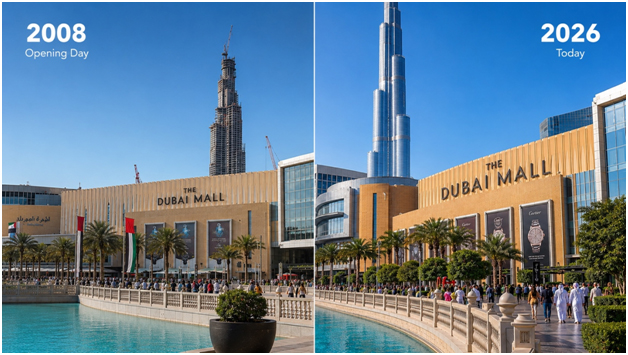
Then: Dubai Mall on Opening Day (2008)
When Dubai Mall opened its doors to the public on November 4, 2008, the world had never seen anything quite like it. Built at a cost of approximately 20 billion dirhams and developed by Emaar Properties, the mall was immediately the largest shopping mall on the planet by total area, covering over 5.9 million square feet of gross floor space. The opening came at a bold moment – just weeks after the global financial crisis had sent shockwaves through international markets – yet Dubai pressed forward with a confidence that defined its character as a city that does not slow down for adversity.
On that opening day, visitors poured through the entrance gates in their thousands, wide-eyed at a space so vast it had its own internal street system, multiple themed zones, and amenities that went far beyond anything a traditional shopping centre had ever offered. The mall launched with over 1,200 retail outlets, an Olympic-sized ice rink, a massive indoor aquarium, and a dinosaur skeleton standing proudly at its centre – a statement of grandeur that set the tone for everything that was to come. The Dubai Fountain outside had not yet been inaugurated, but the promise of what the entire Downtown Dubai district would become was already electric in the air.
The early days of Dubai Mall were not without their challenges. Reaching the mall required navigating what was still a partially developed road network around Downtown Dubai, and the metro link that would later make it more accessible was still under construction. Car parking – though vast – was often overwhelmed on busy weekends. Yet none of this dampened the enthusiasm of visitors who came from across the UAE and from international flights specifically to experience what Dubai had built. Within its first year of operation, Dubai Mall was already attracting over 37 million visitors annually, surpassing even the most optimistic projections.
The retail mix in 2008 skewed heavily toward luxury and international brands, reflecting Dubai’s positioning as a premium shopping destination. High-end fashion houses, jewellers, electronics giants, and global food chains filled the corridors. The atmosphere was celebratory, almost theatrical – a deliberate choice by Emaar to make the mall feel less like a place to shop and more like a destination to experience. That philosophy, revolutionary at the time, would go on to reshape how shopping malls were conceived and built around the world.
Now: Dubai Mall as a Global Icon (2026)
Nearly two decades after its opening, Dubai Mall in 2026 has not merely survived the test of time – it has grown, evolved, and cemented its place as one of the most visited destinations on the planet. Annual footfall now exceeds 100 million visitors, making it busier than many of the world’s most famous tourist landmarks. The mall has undergone multiple expansions since 2008, adding new wings, entertainment zones, dining districts, and experiential attractions that keep the offering fresh and relevant for an ever-changing global audience.
The Dubai Aquarium and Underwater Zoo, which was a headline attraction in 2008, has been regularly upgraded and now offers immersive dive experiences, virtual reality encounters with marine life, and behind-the-scenes access to its conservation programmes. The ice rink continues to host professional skating events and training academies. VR Park, a virtual reality theme park within the mall, has become a major draw for younger visitors seeking cutting-edge entertainment. The mall’s entertainment portfolio now rivals that of standalone theme parks in scale and variety.
The dining scene within Dubai Mall in 2026 is a world unto itself. The restaurant and café count has grown to over 200 outlets representing cuisines from every inhabited continent. The Waterfront Promenade area, overlooking the Dubai Fountain and the Burj Khalifa, has become one of the most sought-after dining locations in the entire city, with reservations at top tables booked weeks in advance. Food halls offering artisan, street-food, and gourmet concepts have been added to meet the demand of a more experience-driven consumer.
From a record-breaking opening in 2008 to a living, breathing city within a city in 2026, Dubai Mall tells the story of Dubai itself – constantly expanding, relentlessly ambitious, and always finding new ways to astonish. What began as the world’s largest mall has become something far greater: a template for what retail, entertainment, and urban experience can look like when imagination is given the space and the resources to run free.
Contributed by GuestPosts.biz