

Dubai Property: From Simple Homes To The World’s Most Active Real Estate Market (2026)
Then: Property in Dubai When a Home Was Just a Home
There was a time in Dubai’s history when the concept of property as an investment, as a financial instrument, as something to be bought and sold and leveraged and traded on international markets, would have been entirely alien to the people who lived there. A home was a home. It was built by the family that lived in it, from the materials the desert and the coast could provide, on land that belonged to the community in the loose, inherited, traditionally governed way that land has been held in tribal societies across the Arabian Peninsula for thousands of years. There were no title deeds, no mortgage products, no off-plan purchases, no real estate agents, no property portals, and certainly no international investors flying in from Moscow or Mumbai or Manchester to snap up a unit in a waterfront development.
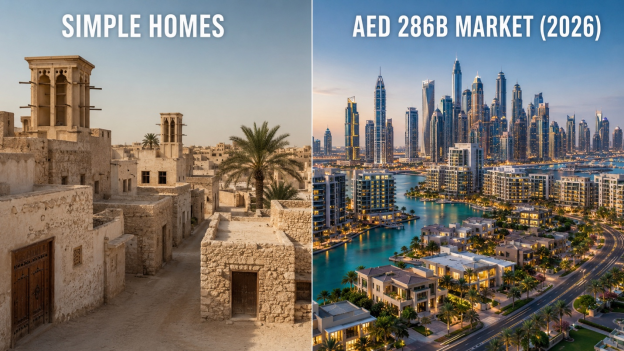
The physical stock of housing in old Dubai reflected the life that was lived in it. Coral stone and mud-brick homes clustered around the creek, their thick walls keeping the interior cool without any mechanical assistance. Palm-frond shelters housed fishing families along the coast. Wind-tower houses, elegant in their functional ingenuity, sheltered the more prosperous merchant families in the Bastakiya quarter. These were buildings designed to endure the desert environment rather than to impress, to provide shelter and community rather than to generate returns. Their value was entirely human rather than financial, measured in the quality of the life they enabled rather than in any price per square foot.
Even as Dubai began to develop rapidly in the 1970s and concrete replaced coral stone as the primary construction material, property remained a largely private and informal affair. The government built public housing for Emirati nationals. Expatriates rented accommodation provided by their employers or found their own through personal networks. The idea of foreigners owning property in Dubai was not merely uncommon – for most of this period, it was legally impossible. The emirate’s land laws did not permit non-nationals to hold property in their own names, a restriction that would only begin to be dismantled in the early 2000s when the decision was made to open Dubai’s real estate market to international ownership as part of a broader strategy to attract global investment and talent.
Now: Dubai Drives AED 286 Billion in Property Transactions in Just Six Months (2026)
The numbers that describe Dubai’s real estate market in 2026 belong to a different universe from the simple homes of old Dubai, and they deserve to be stated plainly so that their scale can be properly appreciated. In the first half of 2026 alone – just six months – Dubai recorded 86,005 real estate transactions with a combined value of AED 286.43 billion. That is approximately seventy-eight billion US dollars of property changing hands in a single emirate in half a year. Residential transactions accounted for the largest share, with nearly eighty thousand home sales worth AED 221.4 billion recorded in the same period. These are not the numbers of a regional property market. They are the numbers of one of the most active, most liquid, and most internationally connected real estate markets anywhere on the planet.
What drives this extraordinary volume of activity is a combination of factors that Dubai has spent decades carefully assembling. The zero property tax environment means that holding costs are minimal compared to comparable markets in London, New York, or Singapore. Rental yields in Dubai consistently outperform those of most global gateway cities, making buy-to-let investment genuinely attractive to international buyers seeking real returns in a stable currency environment. The UAE’s progressive visa policies – including the Golden Visa programme that grants long-term residency to property investors – have created a powerful incentive for global buyers to establish a permanent foothold in Dubai rather than treating it as a holiday purchase. And the quality of what is being built continues to improve, with international developers and world-class architects competing to create residential products of a standard that can hold their own against anything being offered in the most sophisticated property markets in the world.
The buyer profile in 2026 is as global as the city itself. Investors from India, the United Kingdom, Russia, China, Pakistan, France, Italy, and dozens of other nations make up a significant proportion of the transaction volume, drawn by a market that combines strong fundamentals with a lifestyle proposition that is difficult to match anywhere else. First-time buyers are being supported by government initiatives including the expanded First-Time Home Buyer Programme and the Flexi Rent initiative, which are broadening access to homeownership beyond the investor class and creating a more diverse and resilient ownership base. From a community of simple homes where property was barely a concept to the world’s most dynamic real estate market recording nearly ninety billion dollars in transactions every six months, Dubai’s property story is as breathtaking as every other chapter in the extraordinary journey of this remarkable city.
Contributed by GuestPosts.biz