


Dubai City Overview: 1975 vs 2026
Then: Dubai in 1975
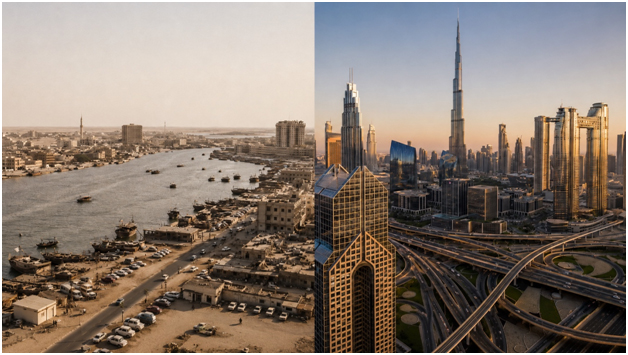
In 1975, Dubai was a city that most of the world had never heard of. What exists today as one of the most dazzling urban landscapes on the planet was, just five decades ago, a modest trading settlement nestled along the banks of the Dubai Creek. The population hovered around 180,000 people, many of whom lived in simple mud-brick homes without air conditioning, reliable electricity, or running water. Life was shaped by the rhythms of the desert, the tides of the creek, and the age-old traditions of fishing, pearl diving, and trade.
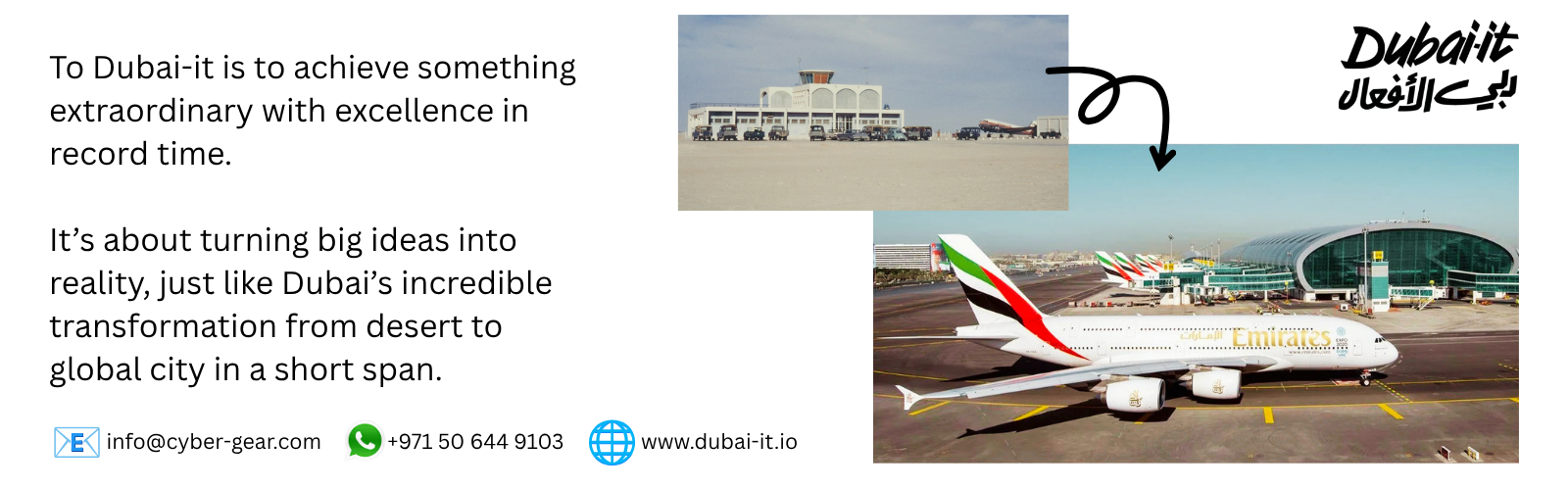
The Dubai skyline in 1975 consisted of little more than a handful of low-rise buildings, a few government offices, and the iconic wind towers of the Bastakiya quarter. The roads were mostly unpaved tracks that connected small neighbourhoods separated by stretches of open sand. There were no shopping malls, no metro lines, and no international airport terminal as we know it today. Travel into and out of Dubai was limited, and the concept of mass tourism was entirely foreign to the region.
The economy in 1975 was just beginning its transformation. Oil had been discovered in the late 1960s, and the revenues were only starting to reshape the emirate’s infrastructure and ambitions. Sheikh Rashid bin Saeed Al Maktoum, the ruler at the time, was already laying the groundwork for what Dubai would become, commissioning the construction of Port Rashid and investing in roads and public services. But to the average resident or visitor of that era, Dubai felt like a quiet, sun-baked town where tradition ruled and modernity was still a distant dream.
The social fabric was tightly knit. Emirati families lived in close communities, and expatriates were relatively few. Markets, known as souks, were the heart of commercial activity, selling spices, gold, textiles, and fresh catch from the Arabian Gulf. The creek was alive with wooden dhow boats carrying goods between Dubai and nearby ports, a tradition that had existed for centuries and continued to define the city’s identity well into the 1970s.
Now: Dubai in 2026
Fast forward to 2026, and Dubai is virtually unrecognisable from its 1975 self. The city is now home to over 3.8 million residents representing more than 200 nationalities, making it one of the most diverse urban environments on Earth. The skyline that was once bare sand and low walls now bristles with glass towers, luxury hotels, and architectural landmarks that draw gasps from visitors arriving for the first time. Dubai has not just grown – it has been reinvented, repeatedly, with breathtaking speed and ambition.
Today, Dubai ranks among the top global cities for business, tourism, real estate, and lifestyle. Its GDP stands at hundreds of billions of dirhams, driven not by oil alone but by trade, finance, real estate, hospitality, technology, and logistics. The government has successfully executed a decades-long strategy to diversify the economy, reducing oil dependency to well below 1% of GDP – a remarkable achievement that few nations have managed to replicate.
The infrastructure of modern Dubai is world-class in every sense. The Dubai Metro, which did not exist until 2009, now serves millions of riders and continues to expand. The city’s road network is among the most advanced in the region. Dubai International Airport is consistently ranked as one of the busiest airports in the world by international passenger traffic, connecting Dubai to virtually every corner of the globe. Smart city technologies embedded in government services, transportation, healthcare, and education have made Dubai a reference point for urban innovation worldwide.
Perhaps most strikingly, Dubai in 2026 is a city where ambition has become architecture. The Burj Khalifa pierces the clouds at 828 metres. Artificial islands have been built from the seabed. Entire new districts – Business Bay, Dubai Marina, Downtown Dubai, Jumeirah Village – have materialised from desert sand within a single generation. What took other global cities centuries to build, Dubai has accomplished in decades. The story of Dubai City from 1975 to 2026 is not just a tale of development – it is one of the most extraordinary transformations in the history of human civilisation.
Contributed by GuestPosts.biz