


Deira Gold Souk: Traditional Trade (1940s) vs Modern Gold Hub (2026)
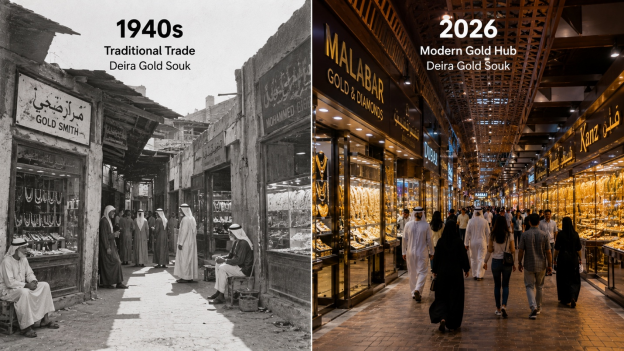
Then: The Deira Gold Souk in the 1940s
Long before Dubai became synonymous with glass towers and luxury malls, it was already building a reputation for one thing above all else – gold. The Deira Gold Souk, which traces its roots back to the 1940s, is one of the oldest continuously operating gold markets in the world, and its story is inseparable from the story of Dubai itself. In those earliest decades, the souk was a modest collection of small shops and stalls clustered in the narrow lanes of Deira, selling jewellery and raw gold to traders, fishermen, pearl divers, and the merchant families who formed the backbone of Dubai’s economy.
In the 1940s and 1950s, Dubai was already emerging as a significant trading hub in the Gulf, partly due to the enlightened tax policies of its rulers who kept import duties low to attract merchants from across the Arabian Peninsula, India, Persia, and East Africa. Gold played a central role in this trading culture. It was used as currency, as savings, as dowry, and as a means of transferring wealth across borders in a region where banking infrastructure was still rudimentary. The goldsmiths who set up shop in Deira were skilled craftsmen, many of them from India and Iran, who fashioned intricate pieces by hand using techniques passed down through generations.
The physical environment of the souk in those early decades was authentically traditional. Narrow covered alleyways provided shade from the desert sun, and the shops were tiny by any modern measure, often just a few square metres in size. Display cases were simple wooden or glass counters, and transactions were conducted through face-to-face negotiation, with the price of gold discussed openly between buyer and seller over cups of cardamom-spiced Arabic coffee. The atmosphere was one of community as much as commerce, with shopkeepers and customers often knowing each other by name across years of repeat visits.
Gold trading in this era was not simply retail. Dubai functioned as a major re-export centre for gold flowing between Europe, Asia, and Africa, and the souk was a critical node in these international supply chains. Dhow boats loaded with gold bars would arrive in Dubai Creek, and the metal would pass through the hands of traders before continuing on its journey. This role as a gold entrepot gave Dubai a commercial significance in the global gold trade that far exceeded what its modest size might have suggested.
Now: Deira Gold Souk as a Global Jewellery Destination (2026)
In 2026, the Deira Gold Souk remains one of the most extraordinary retail experiences in the world, a place where the past and present exist side by side in remarkable harmony. The souk now contains over 300 shops selling gold, diamonds, pearls, and precious stones, and the sheer volume of gold on display at any given moment is staggering – estimated to run into several tonnes at peak trading periods. Walking through its covered arcades, visitors are confronted with window after window of gleaming jewellery in every conceivable style, from traditional Arabic and Indian designs to contemporary European fine jewellery and custom-crafted pieces.
Dubai has consistently ranked as one of the top cities in the world for gold retail, and the Deira Gold Souk sits at the heart of that reputation. The emirate’s zero VAT policy on gold, combined with competitive pricing driven by high trading volumes and low overhead costs, makes Dubai gold prices among the most attractive anywhere globally. Tourists from across Asia, Europe, Africa, and the Americas make dedicated shopping trips to the souk, and it features prominently on virtually every Dubai tourist itinerary. The Dubai Shopping Festival, held annually, consistently sees record gold sales with the souk as its centrepiece.
While the spirit of the souk remains anchored in its traditional trading culture, the experience has been modernised in important ways. Digital payment systems have supplemented cash transactions, international certification standards for diamonds and gemstones are universally applied, and many shopkeepers now communicate with customers in dozens of languages reflecting Dubai’s cosmopolitan visitor profile. The Dubai Gold and Jewellery Group actively promotes ethical sourcing and international quality standards, ensuring that the souk’s global reputation is backed by verifiable quality assurance.
From a handful of traditional gold shops in the narrow lanes of 1940s Deira to the most famous gold market on Earth in 2026, the Deira Gold Souk tells a story of continuity within transformation. The lanes are the same, the gleam of gold is the same, and the spirit of honest trade that Dubai was built upon is very much the same. Everything else – the scale, the reach, the sophistication – has been magnified beyond what any of those early goldsmiths could have imagined.
Contributed by GuestPosts.biz