


Dubai Airport Tops The World In July 2026 With 4.35 Million Seats – By A Significant Margin
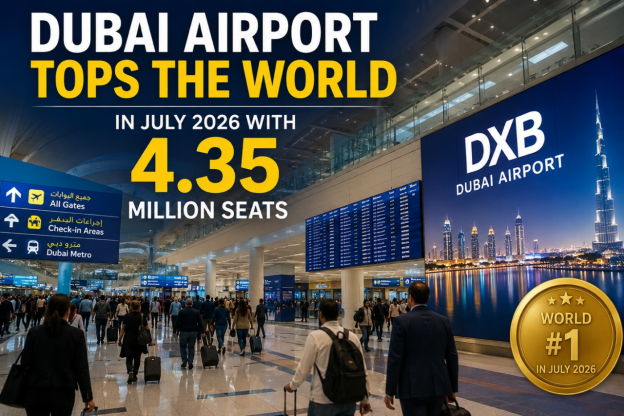
There is a list that aviation data firm OAG – the UK-based company that tracks every published airline schedule on Earth – releases each month, ranking the world’s airports by international seat capacity. It tells you, in the clearest possible terms, which city the world is flying to and from more than any other. For July 2026, that city is Dubai. Dubai International Airport recorded 4.35 million scheduled international seats for the month, making it the largest international airport in the world by seat capacity – ahead of London Heathrow, ahead of Amsterdam Schiphol, ahead of Seoul Incheon, and ahead of Paris Charles de Gaulle. It is not a narrow lead. It is a statement.
The numbers behind the ranking deserve to be read slowly. London Heathrow, arguably the most famous international airport on Earth and the historic home of British Airways, came in second with 4.23 million seats – down one percent from July 2025. Amsterdam Schiphol took third with 3.82 million, up one percent. Seoul Incheon followed with 3.75 million and Paris Charles de Gaulle rounded out the top five with 3.70 million. Dubai’s 4.35 million seats does not just lead this group. It leads by a margin that reflects a genuine and growing structural advantage – one that has been built deliberately, systematically, and over decades.
Eighteen Percent Growth in a Single Year
What makes the July 2026 ranking particularly striking is not just the absolute number but the rate of change behind it. Dubai’s international seat capacity rose 18 percent year on year compared to July 2025. While London declined by one percent and Amsterdam grew by just one percent, Dubai added nearly 660,000 additional monthly seats in twelve months. That is the equivalent of adding a medium-sized airport’s entire monthly output on top of an already record-breaking base. It is growth at a pace that no other major hub in the world is matching, and it reflects the relentless expansion of Emirates airline’s network alongside the continued growth of flydubai, which together make DXB one of the most comprehensively connected airports anywhere on the planet.
The 2025 annual figures provide the full context. Dubai International closed the year with 95.2 million total passengers – its highest annual total on record. That figure was supported by 62.4 million international seats, representing a four percent increase over 2024 and confirming that the trajectory established after the pandemic recovery years is not merely sustained but accelerating. The first quarter of 2026 alone brought 18.6 million passengers through the terminals, suggesting that the full-year 2026 figure will push DXB meaningfully closer to the 100 million passenger milestone that has long been discussed as the airport’s ultimate capacity horizon.
Why Dubai Wins This Race Every Time
The geography is the starting point. Dubai sits within an eight-hour flight of two-thirds of the world’s population, a fact that is not incidental to its position at the top of these rankings but foundational to it. An airline routing passengers between Europe and Asia, between Africa and Australia, or between the Indian subcontinent and the Americas can make Dubai a logical midpoint on virtually any intercontinental journey. Emirates built its entire network strategy around this geographic reality from the day it launched in 1985, and four decades of consistent, capital-intensive expansion of that network has created a connectivity web that competitors find almost impossible to replicate.
But geography alone does not explain an 18 percent year-on-year growth rate while every other major hub in the world is growing at low single digits or declining. That rate of growth reflects active decisions – decisions by Emirates to add frequencies, open new routes, and take delivery of new aircraft at a pace that no other airline is currently matching. It reflects the investment that Dubai Airports has made in terminal infrastructure, ground handling capacity, and passenger processing technology to ensure that increased seat capacity translates into a passenger experience that keeps people choosing DXB over competing hubs. And it reflects the broader positioning of Dubai as a city that people increasingly want to visit as a destination in its own right, not just to transit through on the way somewhere else.
London Heathrow has been the world’s busiest international airport for most of the past century. It is constrained by planning restrictions, runway capacity limits, and the political impossibility of meaningful expansion in one of the world’s most densely populated cities. Dubai has no such constraints. The airport is expanding. The airline is expanding. The city is expanding. The gap between first place and second place in the OAG rankings for July 2026 is 120,000 seats. If the current trajectories continue, that gap will be wider still by July 2027.
Contributed by GuestPosts.biz