



UAE Petrol Just Got Significantly Cheaper – Here Is Why That Matters for Every Driver in Dubai
If you filled up your car in Dubai at the end of June and then filled it up again in the first week of July, you would have noticed something pleasantly surprising on your receipt. The price at the pump dropped – noticeably, immediately, and across every grade of fuel available at UAE petrol stations. The UAE Fuel Price Committee announced the July 2026 retail prices on the last day of June, and the numbers represented one of the more significant monthly fuel price reductions that residents have seen in recent years. For a city where car ownership is essentially universal and daily driving distances are substantial, a fuel price drop of this size has a real and immediate impact on household budgets across the emirate.
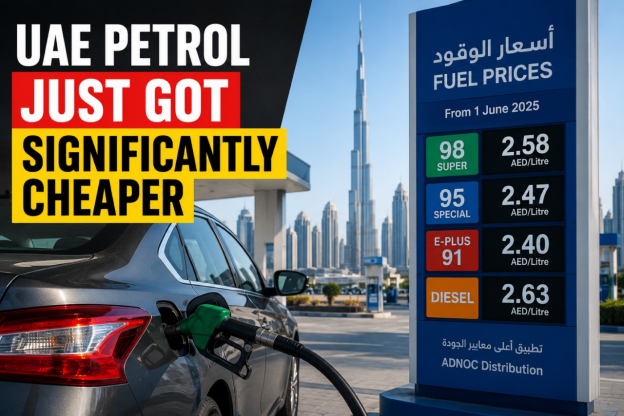
The July 2026 figures tell a clear story. Super 98 petrol, the premium grade favoured by higher-end vehicles, dropped from Dh3.95 per litre in June to Dh3.40 in July – a reduction of Dh0.55 per litre, or roughly 14 percent in a single month. Special 95, the most widely used grade across the UAE’s vehicle fleet, fell from Dh3.83 to Dh3.29, a drop of Dh0.54. E-Plus petrol came down from Dh3.76 to Dh3.21. Diesel, which powers the buses, trucks, and commercial vehicles that keep the city’s logistics network moving, fell from Dh4.33 to Dh3.60 – a reduction of Dh0.73 per litre. All new prices took effect from the first of July 2026.
How the UAE Fuel Pricing System Works
The fuel price drop did not come from a government subsidy decision or a political negotiation. It came from the global oil market, which is exactly how the UAE’s fuel pricing system is designed to work. Since August 2015, the UAE has operated a deregulated fuel pricing model under which the Fuel Price Committee – comprising representatives from the energy sector and relevant government bodies – reviews international crude oil prices at the end of each month and sets the following month’s retail fuel prices in line with prevailing global market conditions.
This system is genuinely unusual in the Gulf region, where most neighbouring countries still maintain heavily subsidised fuel prices that are fixed regardless of what happens on global commodity markets. The UAE made a deliberate policy choice a decade ago to move away from that model, aligning its retail fuel prices with market reality, reducing the fiscal burden of subsidies on the government, and creating a pricing environment that more accurately reflects the true cost of energy. The consequence of that choice is that when global oil prices fall – as they did heading into July 2026, driven by a combination of increased production from OPEC nations and softening demand signals from major economies – UAE drivers benefit directly and immediately at the pump.
What a 14 Percent Drop Actually Saves You
The practical savings from the July price reduction depend on how much you drive and what vehicle you own, but the numbers add up quickly for regular Dubai commuters. A medium-sized SUV with a 60-litre tank, filled once a week with 95 petrol, would have cost approximately Dh229.80 per fill in June. In July, the same fill costs Dh197.40 – a saving of Dh32.40 per week, or roughly Dh130 across the month. Over a full year at these prices, that represents a meaningful reduction in one of the most consistent household expenses for any car-owning family in Dubai.
For commercial operators – the logistics companies, taxi fleets, delivery services, and construction contractors whose diesel bills represent a significant operating cost – the Dh0.73 per litre reduction in diesel prices is even more impactful at scale. A fleet of fifty vehicles, each consuming a hundred litres of diesel per week, saves Dh3,650 per week at July prices compared to June. Over a month, that is nearly Dh15,000 back into a business’s operating budget.
The Bigger Picture: Transparent Pricing in a Region of Subsidies
What is easy to take for granted, living in the UAE, is how relatively transparent and market-responsive the fuel pricing system is compared to what exists elsewhere in the region and beyond. In countries with fixed subsidised fuel prices, the government absorbs the full cost of global price movements – protecting consumers in the short term but creating fiscal pressures and market distortions that compound over time. The UAE’s monthly review system means that the economy adjusts fluidly to global energy market conditions, consumers experience both the benefits of falling prices and the discipline of rising ones, and the pricing signal accurately reflects the real cost of the fuel being consumed. It is a system that rewards efficiency, encourages awareness of energy costs, and keeps one of the most fundamental inputs of daily economic life connected to reality. In July 2026, reality happened to be generous. Every driver in Dubai should enjoy it while it lasts.
Contributed by GuestPosts.biz