



Dubai Safety: Foot Patrols And Trust Then vs a 99.9% Safety Rating (2026)
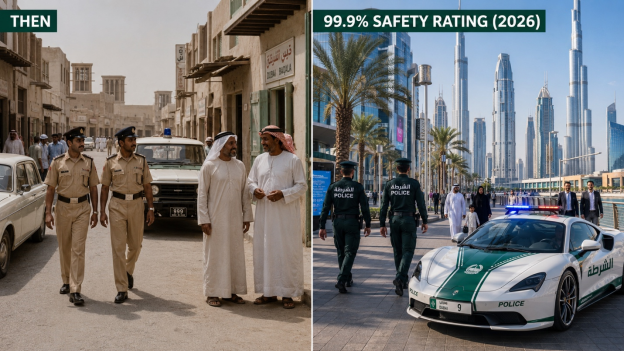
Then: Safety Built on Community and Presence
In the early decades of Dubai’s existence as a modern settlement, the safety and security of the city rested not on technology, not on surveillance systems, and not on sophisticated law enforcement infrastructure, but on something far older and in many ways far more powerful – the tight-knit bonds of a small community where almost everyone knew almost everyone else. Crime was not absent from old Dubai, but it was rare, and the social mechanisms that discouraged it were deeply embedded in the culture of the place. The fear of community shame, the visibility of every resident to every other resident, and the strong tribal and familial accountability structures that governed behaviour in Gulf society created a natural order that formal policing could only supplement rather than replace.
The Dubai Police Force, formally established in 1956 with a handful of officers and the most basic of equipment, operated primarily through presence and relationship rather than technology and enforcement. Officers knew the residents of their patrol areas personally, understood the dynamics of the various communities living side by side along the creek, and relied on the intelligence that comes from genuine human connection rather than from cameras and data systems. When disputes arose – and in a trading city where money, goods, and competing interests regularly came into contact, disputes were inevitable – they were often resolved through mediation and community authority rather than through formal legal process.
As Dubai grew rapidly through the 1970s and 1980s, the simplicity of this community-based safety model came under increasing pressure. A city that had once housed sixty thousand people of largely shared background was suddenly home to hundreds of thousands of residents from dozens of different nations, speaking different languages, operating under different cultural norms, and interacting in a commercial environment of growing complexity and scale. The police force expanded, equipment was upgraded, training was formalised, and the first CCTV cameras began to appear at key locations. But the fundamental approach to safety remained reactive and human-centred – officers responded to incidents, communities reported concerns, and the overall crime rate remained low by international standards because Dubai’s social contract, economic opportunity, and cultural norms continued to make lawbreaking both uncommon and genuinely costly for those who attempted it.
Now: Dubai Achieves a 99.9% Safety Rating in 2026
In 2026, Dubai has achieved something that very few cities anywhere in the world can claim – an officially recorded safety rating of 99.9 percent, a figure that has reinforced the emirate’s standing as one of the most secure major urban environments on Earth and one that places it in a category occupied by almost no other city of comparable size, diversity, and international footfall. This rating is not a marketing claim or a piece of aspirational branding. It is a measurable outcome produced by the combination of one of the world’s most sophisticated law enforcement technology ecosystems, a deeply embedded cultural commitment to social order, and decades of deliberate investment in the systems and institutions that make safety not just an ambition but a daily, verifiable reality.
The technology infrastructure that underpins Dubai’s safety record in 2026 is extraordinary in its scope and sophistication. Thousands of smart cameras equipped with artificial intelligence-powered video analytics monitor public spaces, roads, and commercial areas across the city in real time, automatically detecting suspicious behaviour, traffic violations, unauthorised access, and dozens of other incident types without requiring constant human attention. Facial recognition technology integrated into the network enables the rapid identification of wanted individuals with a speed and accuracy that traditional policing methods could never approach. The Dubai Police smart command and control centre, one of the most advanced of its kind in the world, synthesises data feeds from across the entire city into a single operational picture that allows commanders to deploy resources proactively rather than reactively.
Robotic officers stationed at major public venues interact with visitors, accept minor crime reports, and transmit real-time data back to the operations centre, extending the reach of the force without proportionally expanding its human headcount. Predictive policing algorithms analyse historical patterns of criminal activity to anticipate where and when incidents are most likely to occur, allowing patrol resources to be positioned in advance of need rather than in response to it. The Dubai Police app allows residents and visitors to report concerns, access services, and communicate with the force digitally without visiting a station or making a phone call – removing friction from the safety ecosystem at every point where it might otherwise slow a response.
The result of all of this investment, innovation, and institutional commitment is a city where both residents and visitors consistently report feeling safer than in virtually any other major urban environment they have experienced. International surveys, global safety indices, and the direct testimony of the millions of tourists who visit Dubai every year converge on the same conclusion – that walking its streets alone at night, leaving a bag unattended in a café, or navigating its metro system with expensive luggage carries a level of risk that is as close to zero as any city has ever managed to achieve. From a community of neighbours watching out for each other along a creek to a globally benchmarked safety leader with a 99.9 percent safety rating, Dubai’s security story is, like every other chapter of its history, one of ambition converted into measurable, extraordinary reality.
Contributed by GuestPosts.biz