


Dubai Summer: Empty Streets Then vs Dubai Summer Surprises (2026)
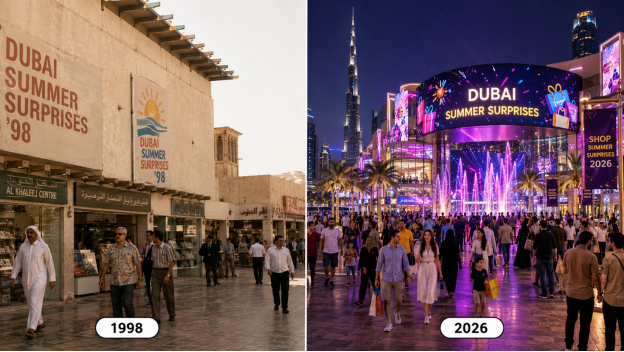
Then: Summer in Dubai Was a Season to Escape
For most of Dubai’s history, summer was not a season to be celebrated – it was a season to be endured, and if at all possible, escaped. The months of June, July, August, and September brought temperatures that regularly exceeded forty-five degrees Celsius, humidity levels that made the air feel like a warm wet blanket pressed against the face, and a general sense that the city was shutting down rather than opening up. Businesses ran skeleton staff. Schools were closed. Embassies operated on reduced hours. Expatriate families who could afford to do so packed their children onto flights to their home countries, returning only when September began to soften the worst of the heat. The city that was vibrantly alive during the cooler months became noticeably quieter, slower, and emptier as summer deepened.
For the residents who remained – the workers who could not leave, the families who had nowhere else to go, the communities for whom Dubai was home in every sense – summer was a test of patience and resilience rather than a period of enjoyment. Air conditioning was the single non-negotiable requirement of daily life, and life was organised almost entirely around the avoidance of outdoor exposure during daylight hours. Streets that were busy with pedestrians in the evenings of December and January lay quiet and bleached white under the summer sun. Shopping centres existed but were modest in scale and limited in entertainment offering. There was simply not much to do, not much to see, and very little reason for anyone from outside Dubai to visit during these months if they had any choice in the matter.
The economic consequences of this summer exodus were significant. Hotels emptied. Restaurants saw business fall sharply. Retail sales dropped across the board as the city’s consumer base contracted with every departing flight. The summer months were, for Dubai’s commercial operators, a period of survival rather than prosperity – costs continued while revenue drained away. For a city that was increasingly reliant on trade, tourism, and retail as economic pillars, the effective loss of a third of the year to inhospitable weather was a serious structural challenge that no amount of ambition could simply wish away. Something had to change.
Now: Dubai Summer Surprises Turns the Dead Season Into a Global Festival (2026)
The answer came in 1998, when Dubai launched the first edition of Dubai Summer Surprises, a government-led initiative designed to do something that seemed almost perverse on its face – to attract people to one of the hottest cities on Earth during the hottest months of the year by giving them compelling enough reasons to stay indoors and spend money. The logic was simple but the execution required both imagination and investment. If you could not change the weather, you could change what happened inside. If you could not make the streets more comfortable, you could make the malls more irresistible. And if you could not stop people from leaving, you could give the ones who stayed, and the ones adventurous enough to visit, an experience they would not find anywhere else.
Twenty-nine editions later, Dubai Summer Surprises in 2026 is one of the most successful seasonal retail and entertainment festivals in the world, and it has completely and permanently transformed the character of summer in Dubai. Running from the second of July to the thirtieth of August across sixty days and nights, the 2026 edition operates under the theme Make It A Dubai Summer and delivers a programme of events, promotions, competitions, concerts, dining offers, and family experiences so comprehensive that it fills an entire season’s worth of calendar space. The festival is organised by the Dubai Festivals and Retail Establishment and backed by the full weight of the Dubai government’s event-hosting machinery, ensuring a scale of delivery that private sector initiatives alone could never achieve.
The retail dimension of Dubai Summer Surprises 2026 is anchored by the Great Dubai Summer Sale, which delivers discounts of up to ninety percent across fashion, beauty, electronics, and homeware at more than fifteen hundred participating stores including the city’s largest and most visited malls. Alongside the sales, the Lucky Receipt promotion rewards shoppers spending over three hundred dirhams with daily prize draws, while the City of Gold campaign offers jewellery buyers spending five hundred dirhams the chance to win three kilograms of gold. In the most dramatic addition to the 2026 edition, the Win Your Home in Dubai campaign – run jointly by the Dubai Festivals and Retail Establishment and Dubai Chambers – enters qualifying shoppers into a draw for twelve residential apartments from Binghatti Developers, including eleven studio units and one two-bedroom grand prize. It is, by any measure, the most extraordinary shopping competition ever staged by a retail festival anywhere in the world.
Entertainment runs alongside the retail programme with equal ambition. The Beat the Heat concert series brings live performances from regional and international artists across multiple weeks. The Modesh World indoor theme park at Dubai World Trade Centre, anchored by Dubai’s beloved bright yellow mascot whose name means amazing in Arabic, draws families from across the UAE and the wider Gulf throughout the festival period. Summer Restaurant Week offers three-course dinners at over fifty restaurants for a fixed price, making the city’s renowned dining scene accessible to a broader audience. From empty streets and departing flights in the summers of the past to a sixty-day festival that fills hotels, malls, restaurants, and arenas with energy, spending, and genuine joy, Dubai has not merely solved its summer problem. It has turned it into one of its greatest commercial and cultural achievements.
Contributed by GuestPosts.biz