


Dubai Payments: Cash And Coins Then vs A 90% Cashless Economy (2026)
Then: A City That Ran Entirely on Cash
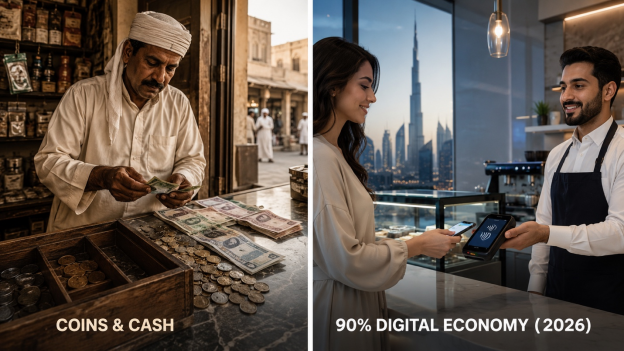
Not long ago, cash was the undisputed language of commerce in Dubai. Whether you were buying spices in the old souk, paying your landlord three months of rent in a single envelope stuffed with notes, settling a restaurant bill, or purchasing gold jewellery worth tens of thousands of dirhams, the transaction almost certainly involved physical money changing hands. Banknotes and coins were not one option among many – they were the only option, and the entire commercial culture of the city was built around the assumption that cash was king, cash was trusted, and cash was how things got done.
The souks of old Dubai were pure cash environments. Merchants kept their daily takings in lockboxes beneath their counters, counted notes by hand at the end of each trading day, and deposited surplus cash at bank branches that operated on limited hours with long queues. Transactions were negotiated verbally, sealed with a handshake, and completed in notes that were folded, counted, recounted, and passed across wooden counters in a ritual as old as trade itself. There were no card readers, no PIN machines, no receipt printers, and no digital record of anything that had been bought or sold. Commerce was human, physical, and entirely analogue in its mechanics.
Even as Dubai modernised through the 1990s and into the 2000s, cash retained its dominance across large parts of the economy. Many landlords required post-dated cheques rather than bank transfers for rental payments – a practice unique to the region that persisted for decades. Labourers and domestic workers were paid their salaries in cash envelopes delivered on payday, with no bank account involved on either side of the transaction. Street food, taxis, small retailers, and market traders operated entirely in cash, and the ATM queues outside banks on the first of every month told their own story about the degree to which physical money still moved through the arteries of the city.
The shift toward electronic payments began gradually in the late 2000s and accelerated through the 2010s as smartphone penetration grew, banking apps improved, and contactless card technology became standard across larger retailers. But even as credit and debit cards became more widely used in hotels, malls, and restaurants, a substantial portion of the economy continued to operate on cash, particularly in the informal sector and among the large communities of migrant workers who had limited access to formal banking services. Dubai was becoming more digital in its upper register while remaining stubbornly cash-dependent at its base.
Now: Dubai’s Cashless Strategy Targets 90% Digital Transactions by End of 2026
In October 2024, Sheikh Hamdan bin Mohammed bin Rashid Al Maktoum, Crown Prince of Dubai, chaired a meeting of the Dubai Executive Council that approved one of the most ambitious financial modernisation programmes ever undertaken by any city in the world. The Dubai Cashless Strategy set a single, clear, measurable goal: ninety percent of all financial transactions across both the public and private sectors in Dubai to be cashless by the end of 2026. The announcement was not aspirational language from a government that had run out of other things to modernise. It was a precisely targeted policy objective backed by a detailed implementation roadmap, a network of public and private sector partnerships, and the kind of executive authority that in Dubai tends to mean that deadlines get met.
By the time the strategy was announced, Dubai already had a remarkable foundation to build on. Official figures showed that ninety-seven percent of Dubai government transactions were already digital, a number that placed the emirate’s public sector among the most cashless government operations anywhere in the world. The Central Bank of the UAE had laid the groundwork for the Digital Dirham. Banking apps from all major UAE financial institutions had matured into fully featured platforms capable of handling virtually every financial need. Over three million people in Dubai were already active users of digital payment systems. The strategy was not starting from zero – it was accelerating an existing trajectory toward a clearly defined destination.
The practical changes being implemented across the city are already visible and increasingly unavoidable. From June 2026, cash payments at parking meters across Dubai were phased out entirely, with drivers directed to pay through a dedicated app, SMS, or contactless card – a small but symbolically significant removal of one of the last everyday cash transactions from urban life. Emirates and flydubai signed agreements with Dubai Finance to promote digital payment adoption among the tens of millions of international passengers who pass through Dubai International Airport annually. The Central Bank launched its Tourist Identity initiative, allowing international visitors to open a digital bank account within minutes of landing in the UAE, reducing their reliance on cash from the first moment of their visit.
The economic case for the strategy is as compelling as the technological one. Official projections estimate that achieving ninety percent cashless transactions will add more than AED eight billion to Dubai’s economy annually through improved efficiency, reduced transaction costs, enhanced financial transparency, and the innovation ecosystem that a digitally mature payments infrastructure makes possible. From a city that counted its commerce in folded banknotes and locked cash boxes to one targeting a position among the top five cashless cities in the world, Dubai’s financial transformation is as complete, as deliberate, and as extraordinary as every other dimension of the story this city keeps writing about itself.
Contributed by GuestPosts.biz