



Intercity Travel In The UAE: Desert Roads Then vs Etihad Rail (2026)
Then: The Long Road Between Emirates
For most of the UAE’s history since its founding in 1971, travelling between the emirates meant one thing and one thing only – getting in a car and driving. There was no other option. No train, no inter-city bus of any reliability, no rapid transit connecting Abu Dhabi to Dubai, or Dubai to Fujairah, or any emirate to any other. The road was everything. The highway that stretches between Abu Dhabi and Dubai, one of the most heavily trafficked intercity corridors in the entire Middle East, became so embedded in the daily routine of hundreds of thousands of commuters, business travellers, and weekend visitors that the journey itself – typically one to one and a half hours in normal traffic, stretching to two hours or more during peak periods – was simply accepted as an inescapable fact of life in the UAE.
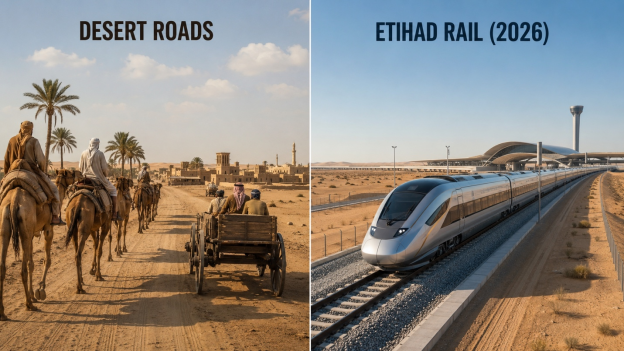
In the earlier decades of the federation, even the roads themselves were not what they would eventually become. The first proper highways connecting the emirates were constructed in the 1970s and 1980s using oil revenues that were being poured into the infrastructure of a young nation building itself from scratch. Before those highways existed, intercity travel was genuinely arduous – unpaved tracks through open desert, unreliable vehicles, and journeys that took many hours under a punishing desert sun with no service stations, no road markings, and no guarantee of a timely arrival. The independence of each emirate meant that connectivity between them was a secondary consideration in the early years, with each territory focused primarily on its own internal development before worrying about the ease of movement to and from its neighbours.
Even as the highways improved dramatically through the 1990s and 2000s, becoming some of the most modern and well-maintained roads in the world, the fundamental limitation remained. The UAE was a nation of drivers, and every person making the Abu Dhabi to Dubai journey was doing it in a private car, generating the kind of traffic volumes that made the corridor one of the most congested in the region during rush hours. Hundreds of thousands of vehicles a day moved between the two cities. Accidents on the highway caused delays that rippled across the entire commuter network. The environmental cost of all those engine hours was enormous. And for the millions of residents who did not own a car or preferred not to drive, intercity travel was simply not a practical option in any meaningful sense.
Now: Etihad Rail Connects the UAE for the First Time (2026)
On 30 June 2026, the United Arab Emirates did something it had never done in its entire fifty-five-year history. It ran a passenger train. Etihad Rail, the national railway operator that had been quietly and methodically building its network for over a decade – beginning with freight operations in 2016 and expanding its nine-hundred-kilometre track across all seven emirates by 2023 – launched its first commercial passenger service, connecting Abu Dhabi and Fujairah in one hour and forty-five minutes across a landscape that would take significantly longer by road. The journey was not just a train ride. It was a statement that the UAE had permanently and decisively expanded its transport identity beyond the road.
The scale and ambition of the Etihad Rail passenger network is considerable. A fleet of thirteen advanced passenger trains, each capable of carrying up to four hundred passengers at speeds of up to two hundred kilometres per hour, forms the operational backbone of a service that will progressively connect eleven cities and towns across the UAE as stations open through 2026 and into 2027. Dubai’s own station at Jumeirah Golf Estates is scheduled to open on 30 September 2026, bringing the capital of the UAE’s commercial and tourism sector into the national rail network for the first time. Tickets start from just fifty-five dirhams in Comfort Class, making the service genuinely accessible to the broad population of residents and visitors who make intercity journeys regularly.
The significance of Etihad Rail’s passenger launch extends far beyond the convenience of individual journeys. It represents a fundamental shift in how the UAE thinks about mobility, connectivity, and sustainability. A nation that built its identity around the private car and the open highway is now investing in shared, low-emission, high-capacity rail transport as a cornerstone of its future infrastructure. By 2030, Etihad Rail aims to carry thirty-six million passengers annually, a number that would make it one of the most significant intercity rail operations in the entire Middle East. A high-speed line between Abu Dhabi and Dubai, capable of speeds up to three hundred and fifty kilometres per hour and reducing the journey to just thirty minutes, is already in feasibility planning. From desert tracks to a national rail network connecting every corner of the federation, the UAE’s journey between its cities has been transformed – and the transformation has only just begun.
Contributed by GuestPosts.biz