



Dubai Getting Around: Camel And Cart vs Flying Taxis In The Sky (2026)
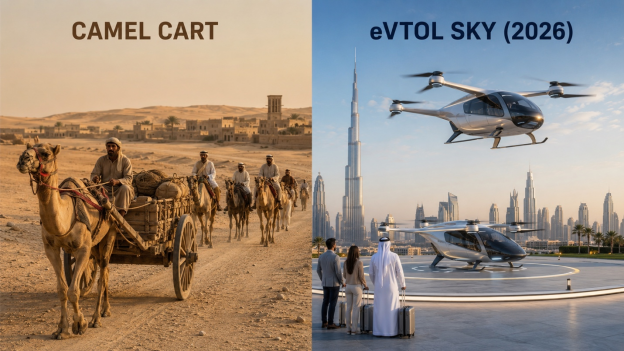
Then: Moving Around Dubai the Old Way
For the greater part of Dubai’s history, the question of how to get from one place to another was answered by the same simple means that had served the people of the Arabian Peninsula for centuries. The camel carried goods and people across the desert. The donkey cart navigated the narrow sandy tracks between homes and markets. The abra – a small flat-bottomed wooden boat – ferried traders and residents across the creek. And when the distances were short and the temperature allowed, people simply walked. There were no traffic jams to complain about, no parking problems to solve, and no infrastructure plans to be debated in committee, because the concept of urban mobility as a planned, engineered, and systematically delivered public service had not yet arrived in a city that was still, in those decades, finding its feet in the modern world.
Even as Dubai began to modernise in the 1960s and 1970s, the mobility options available to ordinary residents remained limited. The first tarmac roads appeared, and motor vehicles became increasingly common among the merchant class and expatriate professionals. Shared taxis – known as service taxis – covered the main routes between Deira and Bur Dubai. A rudimentary bus service existed but was irregular and unreliable. For most people, the private car was the goal, the symbol of having arrived in the modern era, and as Dubai grew and spread further from its original creek-side nucleus, car ownership became not just desirable but practically essential. The city was being built, almost from the beginning, around the assumption that everyone would drive.
That assumption shaped Dubai’s physical geography for decades. Wide roads, generous interchanges, vast car parks, and drive-through everything became defining features of the urban landscape. Getting across the city by car could take five minutes in the early hours and forty-five minutes during the morning rush. Helicopters existed for VIP transport and emergency services, but the idea of ordinary residents being lifted above the gridlock and delivered to their destination through the air in an affordable, scheduled, emissions-free aircraft was the kind of idea that belonged in science fiction – entertaining to imagine but firmly beyond the reach of practical reality. Or so it seemed.
Now: Dubai Launches the World’s First Commercial Flying Taxi Network (2026)
In 2026, Dubai is doing something that no city in the world has done before. It is launching a commercial electric air taxi service – a network of piloted, all-electric vertical take-off and landing aircraft that carry passengers through the Dubai sky at up to 200 miles per hour, bypassing the roads entirely and delivering journeys that take ten minutes instead of forty-five. The aircraft, developed by California-based Joby Aviation under an exclusive six-year agreement with Dubai’s Roads and Transport Authority, are not prototypes or experiments. They are production aircraft, flight-tested across more than forty thousand miles, certified by aviation authorities, and ready to carry paying passengers above one of the most dynamic cities on Earth.
The infrastructure supporting this service is already in place. The UAE became the first country in the world to certify a purpose-built commercial vertiport – the landing and take-off facility for electric air taxis – when the General Civil Aviation Authority granted official certification to the VDX facility near Dubai International Airport in July 2026. Three additional vertiports are under construction, and the full four-node network is expected to be operational before the end of 2026. Passengers will be able to book a Joby air taxi directly through the Uber app, selecting it as a travel option alongside standard car rides, with the service priced at levels comparable to a premium car hire. The aircraft carries a pilot and up to four passengers, produces zero operating emissions, and is quiet enough to fly comfortably over residential and commercial areas without disturbing the city below.
The journey from camel cart to commercial air taxi in just over half a century is, by any measure, one of the most extraordinary leaps in the history of urban transportation. Dubai has not merely kept pace with the global evolution of mobility – it has positioned itself at its absolute cutting edge, becoming the first city in the world to bring electric aerial taxis to its streets, its skies, and its people as a real, bookable, everyday service. The city that once crossed its waterway in a wooden boat and navigated its desert tracks by camel is now asking the world to look up – because that is where Dubai is going next.
Contributed by GuestPosts.biz