


Dubai Entertainment: Desert Nights (1970s) vs World-Class Events (2026)
Then: Entertainment in the Desert Nights of the 1970s
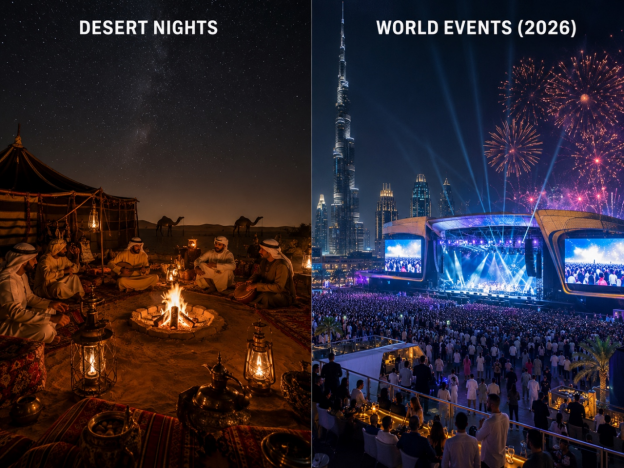
In the 1970s, entertainment in Dubai was a quiet, community-driven affair shaped by cultural tradition, religious observance, and the natural rhythms of desert life. There were no concert arenas, no theme parks, no cinemas showing international releases, and no global sporting events drawing tens of thousands of spectators. Life after dark was largely private – gatherings of family and friends in homes and majlis sitting rooms, where conversation, storytelling, poetry recitation, and music played on traditional instruments like the oud and the tabla formed the core of social entertainment. For Emirati families, the majlis was not just a room but an institution, a space where community bonds were maintained and the oral traditions of Arabian culture were passed from generation to generation.
Outdoor entertainment in the 1970s was intimately connected to the natural environment. Falconry, one of the oldest and most revered traditions of the Arabian Peninsula, was a passion pursued by Emirati men of all ages and social standings. Camel racing was another deep-rooted tradition, with races held on informal desert tracks that drew enthusiastic crowds from across the community. These were not commercialised spectacles but genuine expressions of cultural identity – competitions that connected modern Emiratis to the Bedouin heritage of their ancestors in a direct and meaningful way.
For the small but growing expatriate community of the 1970s, entertainment options were similarly limited. Hotel bars served as gathering places for Western professionals, and informal social clubs organised by various national communities provided a degree of structured leisure. A handful of cinemas existed, primarily showing Indian and Arabic films for the South Asian and Arab expatriate communities. The concept of Dubai as an entertainment destination for international visitors had not even begun to take shape – the city was a place people came to work, not to play.
Yet even in the relative simplicity of 1970s Dubai, there was a social vibrancy that those who experienced it remember with genuine affection. The intimacy of a small city, the warmth of cross-cultural friendships forged in a shared frontier environment, and the spectacular backdrop of desert, sea, and endless sky created a quality of experience that the megacity of 2026, for all its dazzle, can never fully replicate. Entertainment in old Dubai was unscripted, unsponsored, and utterly authentic.
Now: Dubai as a Global Entertainment Capital (2026)
In 2026, Dubai’s entertainment industry is a multi-billion-dirham ecosystem that positions the emirate as one of the premier live event, leisure, and experiential entertainment destinations in the world. The transformation has been total and deliberate, driven by a government that understood early that entertainment is not a luxury but a pillar of economic diversification, quality of life, and international competitiveness. Dubai now hosts world-class events across music, sport, culture, food, technology, and the arts on a scale and with a frequency that rivals cities many times its historical age.
Live music has become a defining feature of Dubai’s entertainment calendar. Global superstars including Coldplay, Beyoncé, Ed Sheeran, and scores of other internationally celebrated artists have performed in Dubai to sold-out audiences at venues including the Coca-Cola Arena – a purpose-built 17,000-capacity indoor arena that opened in 2019 and immediately became the anchor of a world-class live events circuit. The Dubai Opera, opened in 2016 in the heart of Downtown Dubai, brings world-class opera, ballet, theatre, and orchestral performances to a regional audience that previously had to travel to London, Vienna, or New York for such experiences.
Sport has become one of Dubai’s most powerful entertainment platforms. The Dubai World Cup, held annually at Meydan Racecourse, is the richest horse race in the world with a total prize fund of twelve million dollars. The Dubai Duty Free Tennis Championships, the DP World Tour Championship in golf, the UAE Tour in cycling, and regular international cricket and rugby events make Dubai one of the most sports-active cities in the world for a metropolitan area of its size. The Expo City Dubai site, legacy of the world’s fair hosted in 2021 and 2022, has been repurposed as a permanent events and innovation district that continues to draw global gatherings and major exhibitions.
From quiet desert nights and family majlis gatherings in the 1970s to a globally celebrated entertainment capital hosting some of the world’s most spectacular events in 2026, Dubai’s leisure transformation mirrors every other dimension of its extraordinary story. The city has not abandoned its cultural roots – falconry is a UNESCO-recognised heritage tradition and camel racing continues to thrive – but it has layered upon those roots an entertainment infrastructure of global ambition and reach that makes Dubai one of the most exciting cities in the world to live in, visit, and celebrate.
Contributed by GuestPosts.biz