


Dubai Shopping: Souks and Traders vs Malls and E-Commerce (2026)
Then: The Souk Era of Trade and Bargaining
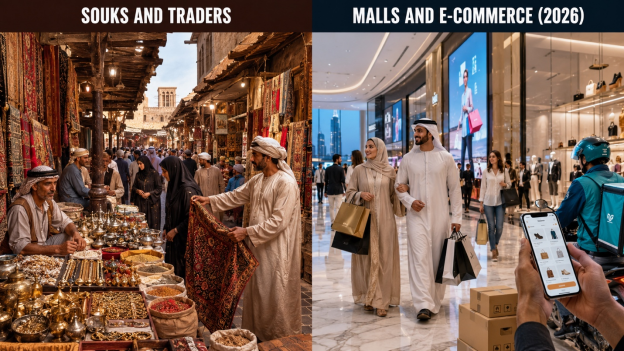
For centuries before the first shopping mall appeared on the Dubai skyline, the souk was the commercial heart of the city. These open-air and covered markets, clustered along the banks of Dubai Creek in the Deira and Bur Dubai districts, were where every transaction took place – from the purchase of daily necessities like bread, fish, and vegetables, to the acquisition of luxury goods like gold jewellery, Persian carpets, and fine Indian textiles. The souk was not merely a marketplace. It was a social institution, a gathering place, a theatre of commerce where the skills of negotiation were as important as the quality of the goods being sold.
The spice souk of Deira was a sensory world unlike anything that exists in modern retail. Burlap sacks overflowing with turmeric, cumin, cardamom, saffron, dried limes, and frankincense lined the narrow covered lanes, filling the air with a layered fragrance that could be detected from streets away. Merchants from India, Iran, Oman, and East Africa traded here alongside local Emirati shopkeepers, and the exchange of goods was always accompanied by the exchange of conversation, news, and strong cardamom coffee. Prices were rarely fixed – every transaction began with an offer and evolved through a ritual of negotiation that required patience, charm, and a genuine knowledge of the market.
The textile souk offered bolts of fabric in every colour and pattern imaginable, catering to the tailoring culture that dominated clothing in the region before ready-made garments became widely available. Tailors worked in small shops adjacent to the fabric merchants, stitching traditional Emirati kanduras and abayas as well as the salwar kameez favoured by South Asian residents and custom-made Western suits for the growing expatriate community. Shopping in this era was an intimate, time-consuming, relationship-driven activity, entirely unlike the transactional efficiency that would come to define modern retail.
Even as late as the 1990s, souk-based shopping remained the dominant retail experience for most of Dubai’s residents. Supermarkets existed but were modest by international standards, branded retail chains were few, and the concept of a shopping mall as a full-day leisure destination had not yet taken hold. The shopping culture of old Dubai was rooted in community, tradition, and the pleasure of human interaction – values that the coming retail revolution would partially displace and partially reimagine in new forms.
Now: Dubai as a Global Retail and E-Commerce Capital (2026)
In 2026, Dubai’s retail landscape is one of the most sophisticated and diverse in the world, spanning everything from ancient souk traditions to cutting-edge e-commerce platforms and immersive phygital shopping experiences that blend the physical and digital in ways that were unimaginable just a decade ago. The emirate is home to over 70 shopping malls of varying scales, including several of the largest and most visited in the world. Dubai Mall alone attracts over 100 million visitors annually, a figure that rivals the visitor numbers of the world’s most famous tourist landmarks.
The range of retail on offer in Dubai in 2026 is staggering in its breadth. Flagship stores of virtually every major global luxury brand – Louis Vuitton, Chanel, Rolex, Ferrari, Hermès – operate in premium mall locations, supported by the emirate’s zero VAT status on most goods and its position as a duty-free shopping destination for the millions of international travellers passing through Dubai International Airport each year. At the other end of the spectrum, hypermarkets, neighbourhood supermarkets, and discount retailers serve the practical daily needs of a population of over four million people representing more than 200 nationalities.
E-commerce has transformed the retail landscape profoundly. Noon.com, the region’s leading e-commerce platform co-founded with significant UAE government backing, competes with Amazon’s Middle East operations to serve a digitally sophisticated consumer base that expects same-day or next-day delivery as a standard. The integration of social commerce – buying directly through Instagram, TikTok, and other social platforms – has opened new retail channels that are particularly powerful among Dubai’s young, digitally native population. Retailers who have survived and thrived in this environment have done so by offering experiences that cannot be replicated online: personalised service, theatrical store environments, exclusive in-store events, and the irreplaceable human dimension of great retail.
Even the ancient souks have adapted. The Deira Gold Souk, the Spice Souk, and the textile markets now welcome millions of tourists alongside local shoppers, their traditional character preserved as both a genuine commercial function and a living heritage experience. In Dubai, the old and the new do not merely coexist – they strengthen each other, creating a retail culture of extraordinary richness that draws on centuries of trading tradition while embracing every innovation the digital age has to offer.
Contributed by GuestPosts.biz