


Jumeirah Beach: Fishing Village (1950s) vs Luxury Coast (2026)
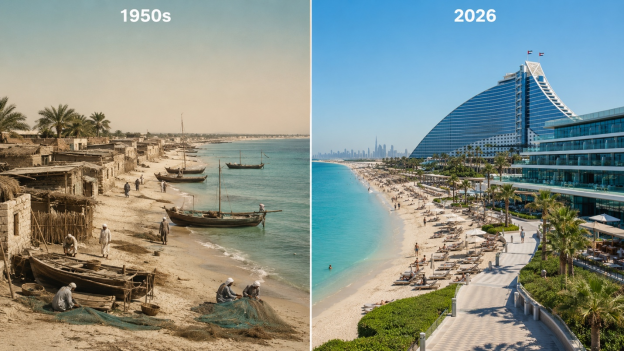
Then: Jumeirah Beach as a Fishing Village in the 1950s
In the 1950s, the stretch of coastline known today as Jumeirah was a quiet, sparsely inhabited strip of land running south of the Dubai Creek settlement along the Arabian Gulf. Small Emirati fishing villages dotted the shoreline at intervals, their simple palm-frond homes and fishing boats defining a way of life that had remained largely unchanged for generations. The sea was not a backdrop to a luxury lifestyle – it was a working environment, the primary source of food and income for the families who lived beside it. Fishermen would set out before dawn in their small wooden boats, casting nets for hamour, kingfish, and prawns in the warm Gulf waters before returning to sell their catch at the creek markets.
The beach itself in those years was untouched in the most literal sense. There were no hotels, no beach clubs, no promenades, and no sun loungers. The white sand and clear turquoise water existed in their natural state, visited only by the fishing families and the occasional Bedouin passing through the coastal corridor. The few expatriates who lived in Dubai during this period – mostly British officials, oil company employees, and traders – would sometimes make the journey to the beach for informal swimming and picnicking, but there was nothing there to suggest that this coastline would one day become one of the most celebrated and luxurious beach destinations in the world.
The Jumeirah area began to change slowly through the 1960s and 1970s as Dubai’s oil wealth started to generate a growing expatriate community that needed housing beyond the crowded creek districts. Low-rise villa developments began to appear along the inland side of the coastal road, and Jumeirah gradually became associated with the residential neighbourhoods of middle and upper-class expatriate families. The beach remained largely public and informal through this period, a place where families gathered on weekends and holidays but where commercial development was still minimal. It retained a simplicity that those who knew it then would come to remember fondly in the years of transformation that followed.
The opening of the Chicago Beach Hotel – later demolished and replaced by the Jumeirah Beach Hotel – in the 1970s marked the first significant step toward commercialising the coastline. But even this was a modest beginning, a single property on a vast stretch of undeveloped shore. The full transformation of Jumeirah Beach into a global luxury destination was still decades away, waiting for the vision and the resources that would eventually arrive together.
Now: Jumeirah Beach as a World-Class Luxury Coastline (2026)
In 2026, Jumeirah Beach is one of the most glamorous and recognisable stretches of coastline anywhere in the world. The shoreline that was home to fishing families in the 1950s is now lined with an almost unbroken succession of five-star resorts, luxury beach clubs, upscale restaurants, and iconic architectural landmarks that draw visitors from every corner of the globe. The transformation has been total and breathtaking – a complete reinvention of a natural coastline into a curated luxury experience of extraordinary ambition and scale.
The Burj Al Arab, rising from its own artificial island just off the Jumeirah coast, is the defining image of this transformation. Opened in December 1999, the sail-shaped hotel is consistently ranked among the most luxurious and recognisable hotels in the world. Its silhouette against the Dubai skyline has become one of the most reproduced images in the history of travel photography, and its presence transformed Jumeirah Beach overnight from a pleasant local amenity into an internationally recognised luxury destination. The Jumeirah Beach Hotel beside it, and the Wild Wadi water park between the two, created a leisure and hospitality cluster that set the template for everything that followed along the coastline.
Today, Jumeirah Beach Road is flanked by a succession of world-class hotel properties including the One and Only Royal Mirage, the Westin Dubai Mina Seyahi, the Habtoor Grand, and dozens more. Private beach clubs such as Nikki Beach, Cove Beach, and Zero Gravity offer day access to pristine beach facilities with full food and beverage service, DJ entertainment, and pool complexes that rival any Mediterranean resort. The public beaches at Jumeirah Beach Park and Kite Beach remain free and accessible, offering well-maintained facilities for residents who want to enjoy the coastline without the luxury price tag.
From a quiet fishing coastline in the 1950s to one of the most sought-after luxury beach destinations in the world in 2026, Jumeirah Beach encapsulates Dubai’s defining story. A natural asset was recognised, respected, and then elevated to a level of global prestige that no one living in those fishing villages could have imagined. The sea has not changed. Everything around it has been reimagined entirely.
Contributed by GuestPosts.biz