



Dubai Police: On-Foot Patrols vs AI and Robocops (2026)
Then: Dubai Police in the Early Days
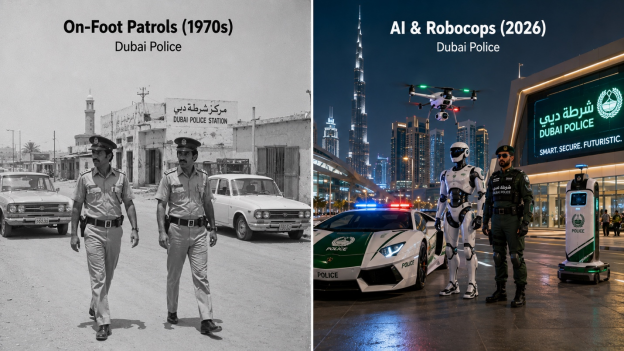
When the Dubai Police Force was formally established in 1956, it consisted of just a handful of officers tasked with maintaining order in a small trading town of a few thousand residents. The founding force was modest in every respect – limited in numbers, basic in equipment, and operating without the benefit of radio communication, motorised vehicles, or forensic investigative tools. Officers patrolled on foot through the narrow lanes of Deira and Bur Dubai, relying on their physical presence, local knowledge, and community relationships to keep the peace in a society where crime was relatively rare and disputes were often resolved through tribal and communal mechanisms.
In those early decades, the role of a Dubai police officer was deeply embedded in the social fabric of the community. Officers knew residents by name, understood the dynamics of the various merchant families and expatriate communities, and served as visible, trusted figures of local authority. The absence of modern technology was compensated for by an intimate familiarity with the city and its people that would become increasingly difficult to maintain as Dubai’s population began to grow rapidly in the 1970s and 1980s. Crime investigation was largely manual, record-keeping was paper-based, and communication between officers in different parts of the city was slow and unreliable.
As oil revenues began to flow in the late 1960s and early 1970s, investment in the police force grew correspondingly. Vehicles were introduced, weapons were upgraded, and training programmes were formalised. The Dubai Police Academy, established in 1987, provided a structured framework for developing local law enforcement talent and introduced international standards of policing practice to an institution that had previously operated largely on tradition and improvisation. By the 1990s, Dubai Police had grown into a recognisable modern law enforcement agency, but it was still operating within the conventional paradigms of patrol, response, and investigation that had defined policing globally for generations.
Through the 1990s and early 2000s, the force continued to grow in sophistication alongside the city it served. CCTV cameras began to appear at key intersections and public spaces, traffic enforcement systems were modernised, and a dedicated tourist police unit was established to address the needs of the growing visitor population. Yet compared to what Dubai Police would become in the following two decades, these advances were still relatively incremental steps along a familiar path.
Now: Dubai Police in the Age of AI and Robotics (2026)
In 2026, Dubai Police is one of the most technologically advanced law enforcement agencies in the world, operating at the frontier of artificial intelligence, robotics, data analytics, and smart city integration in ways that have attracted the attention of police forces globally. The transformation has been deliberate and rapid, driven by Dubai’s broader smart city agenda and a genuine belief within the force’s leadership that technology is not merely a tool for policing but a fundamental reimagining of what policing can be.
The REEM robot, introduced by Dubai Police in 2015 and continuously upgraded since, was among the first robotic police officers deployed in any city in the world. Stationed at major public venues including the Dubai Mall and other high-footfall locations, REEM can interact with members of the public in multiple languages, accept reports of minor crimes, and transmit real-time data back to the operations centre. In 2017, Dubai Police unveiled the Robocop – a fully autonomous patrol robot equipped with cameras, facial recognition software, and an emotional recognition system capable of detecting stress or unusual behaviour in individuals it encounters. These robotic officers are not replacements for human police but extensions of the force’s reach and visibility across the city.
Artificial intelligence runs through virtually every aspect of Dubai Police operations in 2026. Predictive policing algorithms analyse patterns of criminal activity across the city to anticipate where and when incidents are most likely to occur, allowing patrol resources to be deployed proactively rather than reactively. The command and control centre, one of the most advanced in the world, uses AI-powered video analytics to monitor thousands of cameras simultaneously, automatically flagging suspicious behaviour, traffic incidents, and security breaches for human review. Facial recognition technology integrated into the city’s camera network has dramatically improved the speed and accuracy of criminal identification.
From a handful of officers walking the lanes of old Deira in 1956 to a globally pioneering smart law enforcement agency in 2026, Dubai Police represents one of the most dramatic institutional transformations in the emirate’s history. The force has not abandoned the community-centred values of its founding era – it has amplified them with technology, extending its reach, improving its response, and making Dubai one of the safest major cities in the world. The future of policing is being written in Dubai, one algorithm and one robot at a time.
Contributed by GuestPosts.biz