


Dubai Creek: The Old Trading Heart vs Heritage Tourist Spot (2026)
Then: Dubai Creek as the Beating Heart of Trade
If there is one geographical feature that made Dubai what it is today, it is Dubai Creek. This natural saltwater inlet, stretching approximately 14 kilometres inland from the Arabian Gulf, was not merely a body of water – it was the economic and social lifeblood of an entire civilisation for centuries. Long before the first skyscraper rose from the desert sand, before the metro lines were drawn across the map, and before the name Dubai meant anything to the wider world, the creek was already busy with trade, movement, and community. It was, in every meaningful sense, the reason Dubai existed where it did.
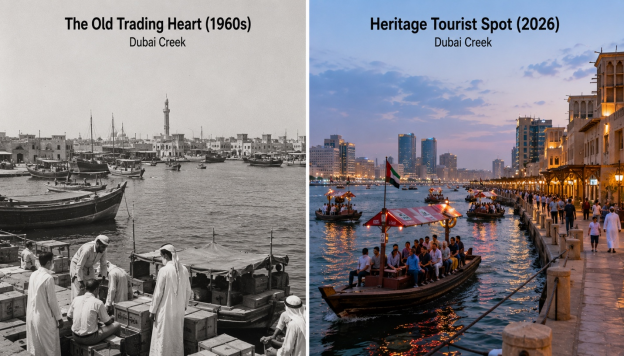
For centuries, Dubai Creek served as a natural harbour that sheltered the wooden dhow boats of Arab, Persian, Indian, and East African traders. The creek’s geography – wide enough to accommodate significant vessel traffic, shallow enough to be navigable by traditional boats, and deep enough to provide protection from Gulf storms – made it an ideal base for maritime commerce. Merchants would anchor their dhows along the waterfront, unloading goods ranging from spices, textiles, and pearls to dried fish, dates, and copper, creating a constant bustle of commercial activity that defined the rhythm of daily life for everyone living on its banks.
The two sides of the creek gave birth to two distinct but complementary communities. On the northern bank, Deira grew as the primary commercial district, home to the gold souk, the spice souk, the textile souk, and countless trading houses that handled goods flowing through the port. On the southern bank, Bur Dubai developed as a more residential and administrative area, housing the ruling family’s fort – Al Fahidi Fort, now the Dubai Museum – and the neighbourhoods of the various merchant communities that had settled there. The creek was the boundary and the bridge between these two worlds simultaneously.
The abra, a small flat-bottomed wooden water taxi, was the primary means of crossing between Deira and Bur Dubai for most of the twentieth century. For a few fils, residents could make the short but essential crossing dozens of times a day, and the abra operators were as much a part of the creek’s social fabric as the merchants and fishermen who worked its banks. The creek was never silent – always alive with the sound of engines, oars, the calls of traders, and the lapping of water against the hulls of moored dhows.
Now: Dubai Creek as a Heritage and Cultural Destination (2026)
In 2026, Dubai Creek still exists and still flows, but its role in the life of the city has been fundamentally transformed. The commercial functions that once made it indispensable have largely migrated to the purpose-built ports, free zones, and business districts that now define Dubai’s economic geography. Jebel Ali Port, opened in 1979 and today one of the largest container ports in the world, handles the vast majority of Dubai’s maritime trade. The creek’s days as a working commercial harbour on any significant scale are largely behind it, but what has replaced that function is something equally valuable – a living museum of Dubai’s origins and identity.
The Al Seef district, developed along the Bur Dubai bank of the creek, is one of the most thoughtfully designed heritage and leisure destinations in the region. A careful blend of restored traditional architecture, recreated souk-style retail streets, waterfront promenades, and contemporary dining outlets, Al Seef offers residents and tourists a genuinely immersive experience of what old Dubai looked and felt like, without sacrificing the comfort and convenience of modern amenities. The district hosts cultural events, art installations, and community markets that draw visitors throughout the year.
The Dubai Museum, housed in the historic Al Fahidi Fort on the Bur Dubai side of the creek, remains one of the most visited cultural attractions in the emirate. The surrounding Al Fahidi Historical Neighbourhood – a carefully preserved collection of traditional wind-tower buildings that once housed merchant families – has been transformed into a creative and cultural district home to art galleries, boutique cafés, and the Sheikh Mohammed Centre for Cultural Understanding. Together, these sites give the creek corridor a cultural density that contrasts beautifully with the modernity of the wider city.
The abra still crosses the creek today, carrying tourists and nostalgic residents between Deira and Bur Dubai for a fare that remains symbolic in its modesty. Traditional dhows still bob in the water, some converted into floating restaurants offering dinner cruises along the illuminated waterway. From the trading lifeline of a pre-modern city to a cherished heritage corridor in 2026, Dubai Creek has completed a remarkable journey – from necessity to memory, and from commerce to culture – without ever losing the quiet magic that made it special in the first place.
Contributed by GuestPosts.biz