

Burj Khalifa: Construction Era (2004) vs Icon Of Today (2026)
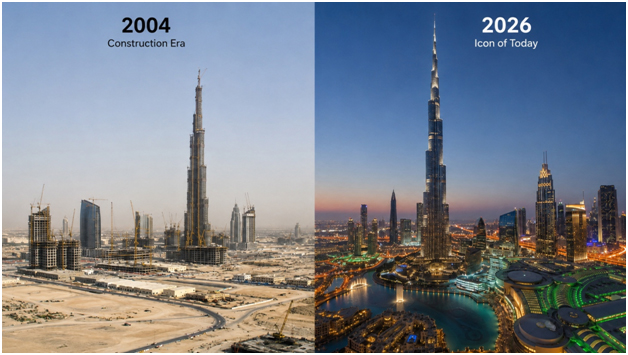
Then: The Burj Khalifa in 2004
In January 2004, workers broke ground on a construction site in Downtown Dubai that few outside of a small circle of architects, engineers, and government officials fully understood. The project was known at the time simply as Burj Dubai – the Dubai Tower – and the ambition behind it was so audacious that even seasoned construction professionals struggled to process it. The goal was to build the tallest structure in the history of humanity, surpassing every record ever set, on a patch of desert that had been largely undeveloped just years before.
The scale of the undertaking in 2004 was staggering. The project was designed by the Chicago-based architectural firm Skidmore, Owings and Merrill, led by architect Adrian Smith. The structural concept drew inspiration from the Hymenocallis flower, with three lobes extending from a central core – a design chosen not just for aesthetics but to maximise structural stability and reduce wind forces on the tower at extreme heights. Engineers had to develop entirely new techniques to pump concrete to heights never attempted before. The construction site quickly became one of the most complex engineering challenges ever undertaken.
During the peak of construction between 2005 and 2008, over 12,000 workers were on site every single day. The workforce came from across South Asia and Southeast Asia, working in gruelling desert heat to push the tower higher week by week. At its most intensive phase, the building rose at a rate of roughly one floor every three days. More than 330,000 cubic metres of concrete and 55,000 tonnes of steel rebar were used in the process. The logistics alone – coordinating materials, machinery, and thousands of workers across over 160 floors – were a feat of project management that had no precedent in modern construction history.
The surrounding area in 2004 and the years that followed was largely a construction zone. Downtown Dubai, which would eventually become one of the most prestigious and visited urban districts in the world, was at that time a sea of cranes, temporary roads, and foundation works stretching in every direction. The vision of a world-class downtown neighbourhood with luxury hotels, a massive shopping mall, dancing fountains, and residential towers was entirely on paper. Only the ambition – and the relentless momentum of Dubai itself – made it feel real.
Now: The Burj Khalifa in 2026
More than two decades after that first shovel hit the ground, the Burj Khalifa stands as the defining symbol of modern Dubai and one of the most recognised structures on Earth. Rising 828 metres into the sky across 163 floors, it remains the tallest building in the world as of 2026, a title it has held since its grand opening on January 4, 2010. What was once a daring blueprint is now a daily reality – visited by millions, photographed billions of times, and embedded in the global imagination as a monument to human possibility.
The Burj Khalifa in 2026 is far more than a tall building. It is a fully functioning vertical city. The tower houses luxury residences, the Armani Hotel Dubai, corporate offices, observation decks on the 124th and 148th floors, and high-end restaurants including At.mosphere, one of the highest dining venues in the world. The observation decks, known as At the Top, welcome thousands of visitors every day, offering views that stretch across the Arabian Gulf, the desert, and the entire metropolitan sprawl of Dubai below.
The neighbourhood around the Burj Khalifa has been transformed just as dramatically. Downtown Dubai is now a thriving district anchored by the Dubai Mall – the largest shopping mall in the world by total area – and the Dubai Fountain, the world’s largest choreographed fountain system. The area draws tens of millions of visitors annually and hosts some of the most spectacular New Year’s Eve fireworks displays on the planet. Property values in the shadow of the Burj Khalifa rank among the highest in the entire Middle East.
From a muddy construction site in 2004 to a globally iconic landmark in 2026, the Burj Khalifa captures the essence of Dubai’s relentless drive to dream bigger than anyone thought possible. It is not merely a building – it is a statement that in Dubai, the sky has never been a limit, but a starting point.
Contributed by GuestPosts.biz