

People Of Determination: The Word Dubai Gave The World
Words carry weight. The language we use to describe people shapes how society sees them, treats them, and ultimately values them. For most of modern history, the words used to describe people living with disabilities have reflected limitation – what a person cannot do, what they lack, what sets them apart from an assumed norm. Handicapped. Disabled. Differently-abled. Each term was an improvement on the last, but each still carried the shadow of deficit. In April 2017, the UAE did something that no country had done before. It replaced the word entirely – and the replacement it chose was so precisely right that it has since been adopted across governments, institutions, and organisations around the world.
Sheikh Mohammed bin Rashid Al Maktoum, Vice President and Prime Minister of the UAE and Ruler of Dubai, introduced the term People of Determination at the launch of the National Strategy for Empowering People of Determination. His reasoning was as simple as it was powerful. Disability, he said, is in fact the inability to make progress and achievements. The achievements that people of determination have made in various spheres over the past years are proof that determination and strong will can do the impossible. He was not rebranding a group of people. He was reframing an entire social conversation – shifting the lens from what someone cannot do to what they have already accomplished.
Why the Language Matters More Than You Think
The shift from disabled to People of Determination is not semantics. Research consistently shows that the language used to describe a group of people directly influences how institutions treat them, how employers think about hiring them, how educators approach teaching them, and how society at large extends dignity and opportunity to them. When you call someone disabled, you are leading with what they cannot do. When you call someone a Person of Determination, you are leading with what they have chosen to do despite every obstacle placed in their path. That is not a small distinction. It is the entire difference between pity and respect.
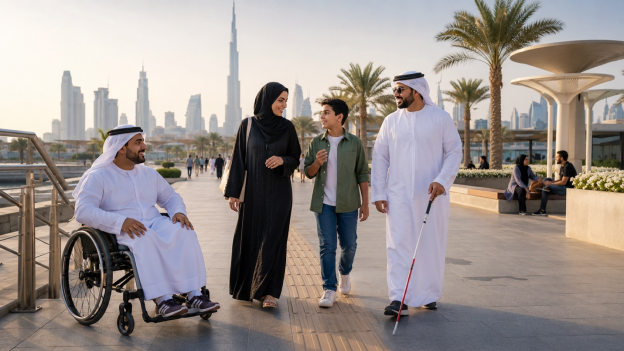
The UAE backed the new terminology with concrete legal and institutional infrastructure. Federal Law No. 29 of 2006 guaranteed rights for people with disabilities. Sheikh Mohammed issued Law No. 3 of 2022 on the rights of People of Determination in Dubai specifically, establishing a permanent Higher Committee to Protect their Rights and mandating their inclusion in the drafting of policies that affect their lives. The law covers education, employment, healthcare, accessibility, and the built environment – requiring government buildings, public spaces, transport systems, and service providers to be designed around the needs of People of Determination rather than treating accessibility as an afterthought.
What Dubai Has Built Around the Term
The infrastructure of inclusion in Dubai in 2026 is extensive. The Dubai Code for People of Determination-Friendly Buildings sets accessibility standards for every new structure in the emirate. The Community Development Authority provides dedicated services, financial assistance, and support programmes. Seven academic centres serve over 800 Students of Determination annually. Public transport across the UAE offers free services for People of Determination in several emirates. A dedicated UAE sign language dictionary standardises communication for the hearing-impaired community across the country. A new logo introduced in 2019 – replacing the old wheelchair symbol – depicts an active, forward-moving figure, chosen specifically to emphasise independence, self-determination, and full participation in society.
The world did not have a better word for this community before Dubai created one. It does now. People of Determination is used today in international contexts, adopted by organisations in multiple countries, and referenced in global disability advocacy as a model of inclusive language. A small country in the Gulf coined a phrase in 2017 that is quietly reshaping how the world talks about one of its largest and most consistently underserved communities. That is the kind of influence that does not come from size or history. It comes from having exactly the right idea at exactly the right moment and the courage to put it into the world.
Contributed by GuestPosts.biz