


Dubai Is Building A 93-Kilometre Indoor City Where You Never Need A Car
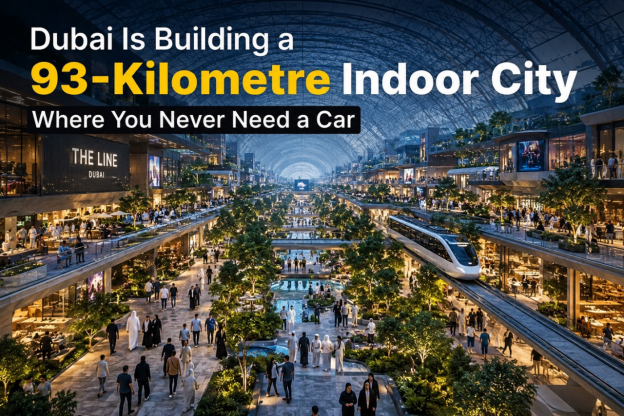
Most cities dream about becoming more walkable. They add a pedestrian street here, a bike lane there, and hold a press conference about sustainable urban futures. Dubai, characteristically, has decided to build an entirely new category of infrastructure – a 93-kilometre climate-controlled loop that runs through the city, connects its key destinations, and makes walking and cycling comfortable even in the middle of August when the temperature outside is hovering at 45 degrees Celsius and the humidity is doing everything it can to make that feel worse. The project is called The Loop, and it is either the most ambitious urban mobility initiative ever attempted or the most spectacularly Dubai thing Dubai has ever proposed – quite possibly both at once.
Designed by the UAE-based architecture and urban design studio URB, The Loop is conceived as a fully enclosed, zero-emissions corridor that wraps around the city in a continuous circuit, maintained at a constant internal temperature of around 23 degrees Celsius year-round. Imagine stepping off your street and into a long, air-conditioned green corridor – not a mall, not a metro station, but an active urban pathway filled with indoor parks, landscaped greenery, vertical farms, and community spaces – and being able to walk or cycle from your neighbourhood to your office, your school, your clinic, or your favourite restaurant without once stepping back into the heat. That is the experience The Loop is designed to deliver.
What Is Actually Inside the Corridor
The Loop is not simply a covered pavement. The design integrates biophilic elements throughout – living plant walls, indoor parks, natural light filtered through engineered glazing, and air quality systems designed to feel genuinely refreshing rather than simply not-hot. Vertical farms embedded along the corridor will grow produce that can supply residents and businesses directly, shortening food supply chains and contributing to the emirate’s food security ambitions. Kinetic flooring technology, which generates electricity from the footsteps of the thousands of people walking along the corridor daily, will contribute to the energy needs of the loop itself. The entire infrastructure is proposed to run on one hundred percent renewable energy, with solar panels integrated into the outer surface of the structure providing the primary power source.
The commercial and community layer within The Loop is equally considered. Retail units, cafés, health clinics, co-working spaces, pharmacies, and service providers will be distributed along the corridor at intervals designed to ensure that the vast majority of daily needs are accessible without exiting the loop at all. This is the twenty-minute city concept taken to its most literal possible expression – not a planning aspiration but a physical environment engineered to make every essential destination reachable on foot within a fixed time window.
The 20-Minute City Goal by 2040
The Loop sits within Dubai’s broader urban master plan ambition that by 2040, eighty percent of residents should be able to reach their daily needs – work, education, healthcare, retail, recreation – by foot or bicycle rather than by car. That is an extraordinary target for a city that has been built, almost entirely, around the private automobile. Every major road in Dubai is wide. Every major destination has a car park. The assumption that you will drive has been embedded into the physical design of the city for decades. The Loop is the most dramatic single intervention in the long process of undoing that assumption and replacing it with something healthier, quieter, cleaner, and frankly more pleasant for the people who actually live here.
The project is currently in the planning and feasibility stage, being studied and integrated into Dubai’s long-term urban infrastructure roadmap. No construction start date has been officially confirmed, and a project of this complexity and ambition will require years of engineering, regulatory, and financing work before the first section opens to the public. But in Dubai, the gap between ambitious concept and physical reality has historically been much shorter than anywhere else on Earth. The city that built a palm-shaped island in the sea, the world’s tallest building, and a driverless metro system from scratch is now proposing a 93-kilometre air-conditioned walking loop. The only genuinely surprising thing about this is that nobody built it sooner.
Contributed by GuestPosts.biz