


The Engineering Behind Dubai’s Palm Jumeirah – Land Reclaimed From the Sea
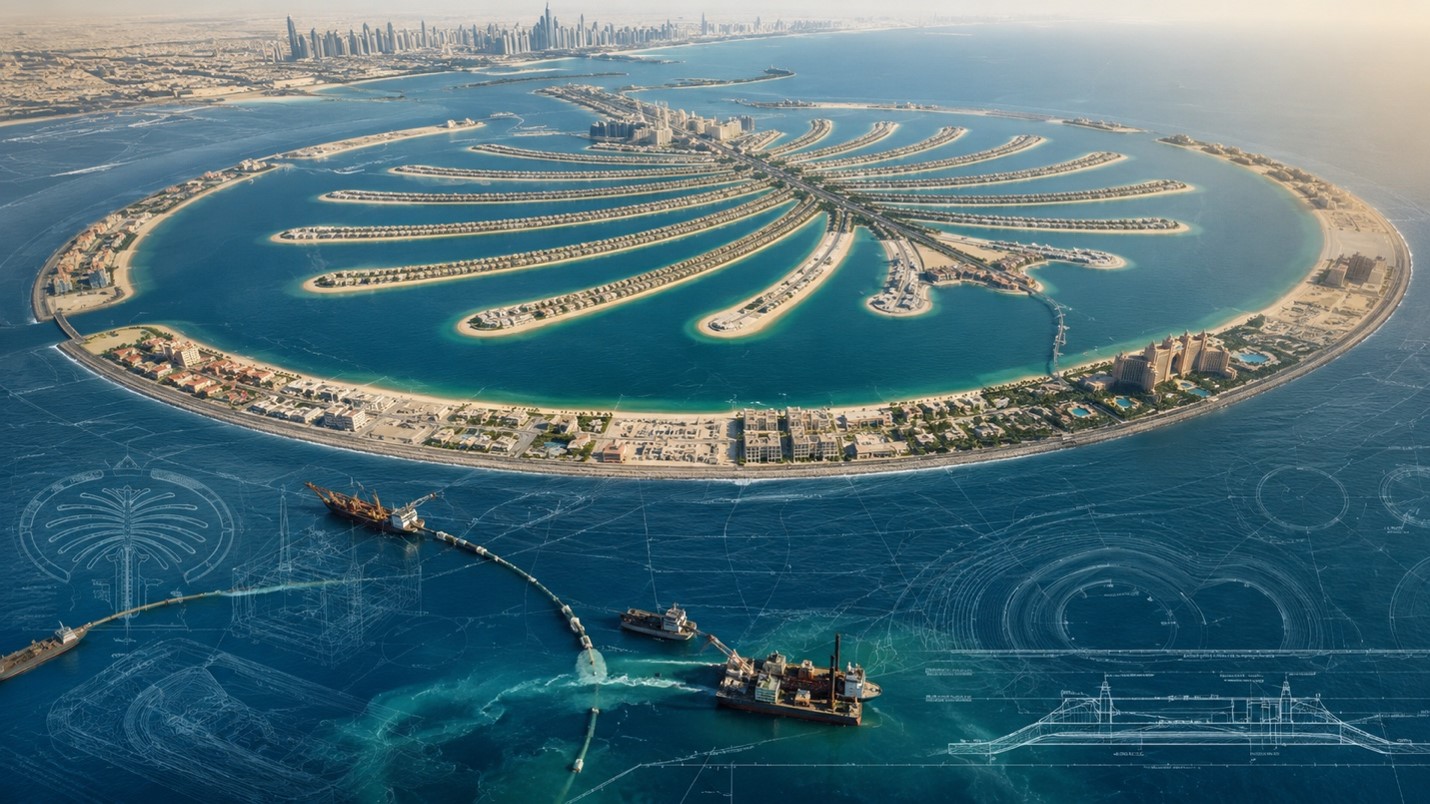
Seen from above, Palm Jumeirah looks almost unreal: a giant palm tree stretching into the Arabian Gulf, its trunk lined with towers and its seventeen fronds packed with villas. It remains one of the most recognizable pieces of land reclamation ever built, and more than two decades after construction began, it’s worth revisiting how – and why – Dubai pulled it off.
The project started in 2001, driven by a simple but pressing problem: Dubai’s natural coastline was only about 70 kilometers long, limiting how much waterfront property the emirate could develop. Rather than accept that constraint, planners decided to manufacture more coastline. Palm Jumeirah alone added roughly 78 kilometers of new beachfront by extending land out into the sea in a shape that maximized villa frontage per square meter.
Building it required moving an extraordinary volume of material. Engineers dredged around 94 million cubic meters of sand from the Gulf floor, spraying it into place through a technique called rainbowing, where sand is shot high into the air from a pipe and allowed to fall into position, layer by layer. Once the shape was formed, vibro-compaction – essentially vibrating the loose sand until it settled into a dense, stable base – was used to prepare the ground for construction. A surrounding crescent-shaped breakwater, built from around seven million tons of rock, was added to protect the fronds from wave erosion and storm surges.
One detail that often surprises people is that the island’s crescent breakwater isn’t solid; it includes gaps specifically engineered to keep water circulating between the fronds. Without this, the enclosed lagoons risked becoming stagnant, which would have caused ecological problems and made the surrounding water unusable for swimming or marine life.
Palm Jumeirah was also a proving ground for Dubai’s broader reclamation ambitions, which later extended to Palm Jebel Ali and the now-shelved Palm Deira project. It became a template – commercially and technically – for how artificial islands could be marketed as ultra-premium real estate rather than purely functional infrastructure. Villas on the fronds and apartments along the trunk were sold before construction even finished, with the scarcity of “waterfront within a waterfront” driving prices well above typical Dubai property rates.
The engineering wasn’t without complications. Some early villa owners reported settling issues as the reclaimed land compacted over time, and there were periods when water quality in the enclosed lagoon areas drew environmental criticism due to limited circulation before the breakwater gaps were adjusted. Marine biologists have also pointed out that large-scale reclamation projects like this can disrupt natural seabed habitats, and Palm Jumeirah has been studied as both an engineering success story and a case study in the ecological trade-offs of coastal development.
Today, the island is home to luxury hotels, private beach clubs, and thousands of residents, and it remains a key symbol of how Dubai approaches physical limitations: not as constraints to work around, but as problems to be engineered away entirely. Whether or not future cities attempt anything on this scale again, Palm Jumeirah still stands as proof of what’s possible when ambition, sand, and enough engineering budget come together.
Contributed by GuestPosts.biz