


Dubai’s Museum of the Future – A Window Into Tomorrow
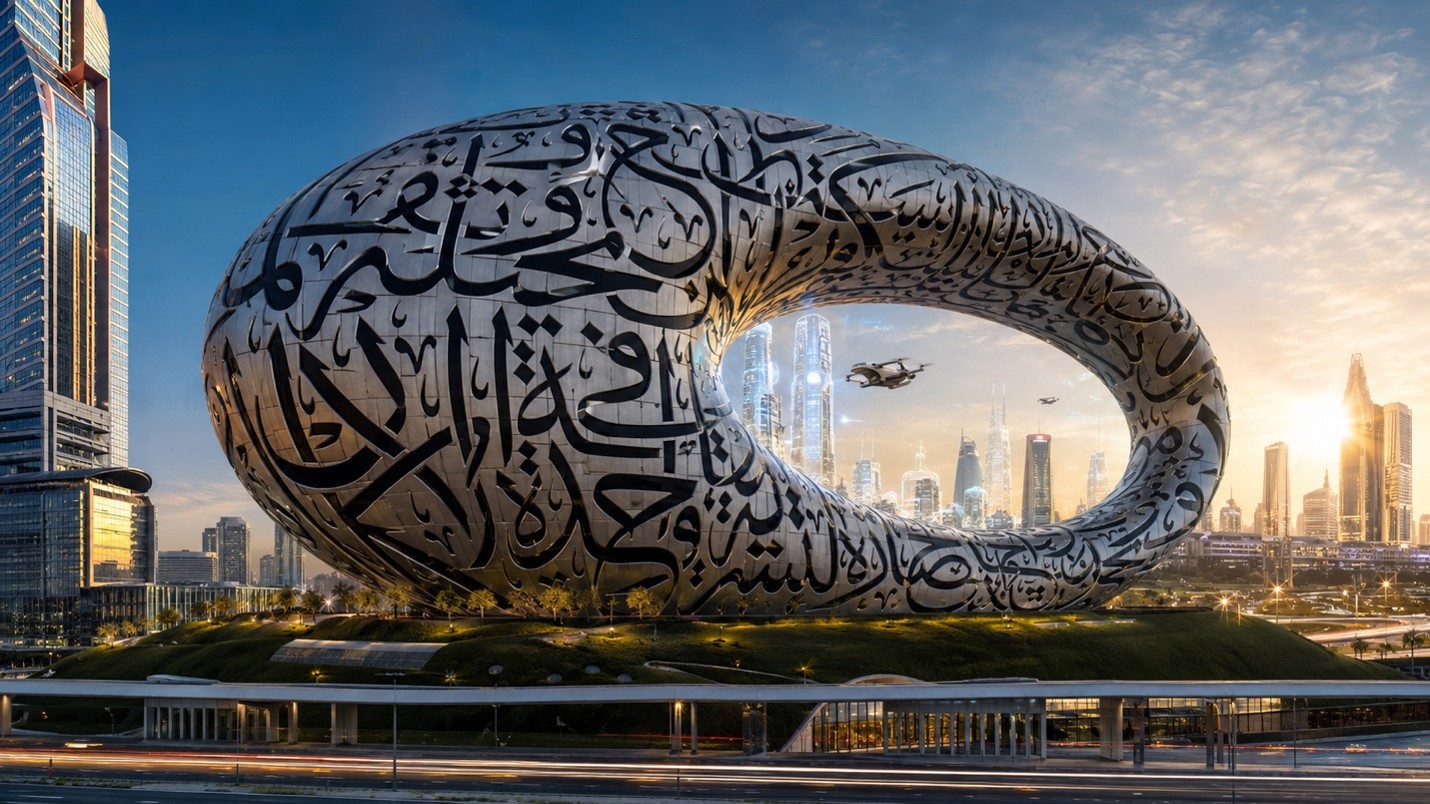
Few buildings in the world generate the kind of instant recognition that Dubai’s Museum of the Future does. Its torus-shaped silver exterior, wrapped in Arabic calligraphy quoting the words of Sheikh Mohammed bin Rashid Al Maktoum, has become one of the most photographed structures on the planet since it opened in 2022. But beyond its striking silhouette, the museum represents something far more ambitious: an attempt to turn speculative thinking about the future into a tangible, walkable experience.
Located on Sheikh Zayed Road, the museum’s design alone is a feat of engineering. The stainless-steel facade features more than 1,000 unique panels, each cut using robotic arms to display calligraphy that was never repeated elsewhere on the building. Inside, there are no straight corridors – visitors move through a green, hollow void meant to symbolize the unknown territory of what lies ahead.
The exhibits themselves lean heavily into immersive storytelling rather than static displays. One floor imagines a space station orbiting Earth in 2071, complete with recreations of alien ecosystems engineered by future scientists. Another explores the Amazon rainforest as it might look decades from now, blending real biological research with speculative design. A dedicated children’s floor, Al Waha, lets younger visitors experiment with sustainability concepts through play, from farming simulations to renewable energy games.
What makes the museum particularly interesting from a cultural standpoint is its role in Dubai’s broader identity strategy. The city has long branded itself around superlatives – the tallest tower, the largest mall, the most luxurious hotel – but the Museum of the Future signals a shift toward positioning Dubai as a hub for ideas and innovation, not just scale. It works closely with real scientists, futurists, and engineers to ground its exhibits in plausible technological trajectories rather than pure fantasy, which gives the experience a credibility that many “future-themed” attractions lack.
The museum also functions as a working innovation lab. Behind the public exhibits, it houses incubator spaces for start-ups and researchers focused on healthcare, energy, and urban design, alongside partnerships with global universities and companies. This dual identity – part tourist attraction, part functioning research initiative – is part of what has kept it relevant well past its opening buzz.
Ticket demand has remained strong, with the museum regularly ranking among the top paid attractions in the UAE. For visitors, the appeal isn’t just the architecture or the Instagram moment at the entrance; it’s the rare experience of a museum that asks open-ended questions rather than presenting settled history. Visitors leave not with facts memorized, but with scenarios to think about – what cities, ecosystems, and even human biology might look like in fifty years.
Critics have occasionally noted that some exhibits feel more like elaborate set design than substantive science communication, and that ticket prices put it out of reach for many residents. Still, as a piece of architecture and a statement of intent, the Museum of the Future has succeeded in doing what few buildings manage: making people curious about a city’s relationship with time itself. For a metropolis built almost entirely in the last half-century, a museum obsessed with what comes next feels less like a gimmick and more like a natural extension of Dubai’s own story.
Contributed by GuestPosts.biz