




Dubai Just Gave Its Entire Bus Network A Brain – Here Is What That Means For You
The Everyday Problem Nobody Talks About Enough
Everyone in Dubai has a metro story. The clean stations, the air conditioning, the punctuality that makes you feel like the city actually respects your time. But not everyone uses the metro, because not everyone lives or works near a metro station. For a huge number of people in this city – residents in communities that the rail network does not reach, workers commuting to areas served only by road, families without a car – the bus is not a backup option. It is the only option. And for years, the bus network, despite being large and widely used, has operated the way most bus networks around the world operate: on a fixed schedule, managed by human dispatchers doing their best with limited real-time information, and largely unable to adapt quickly when things go wrong.
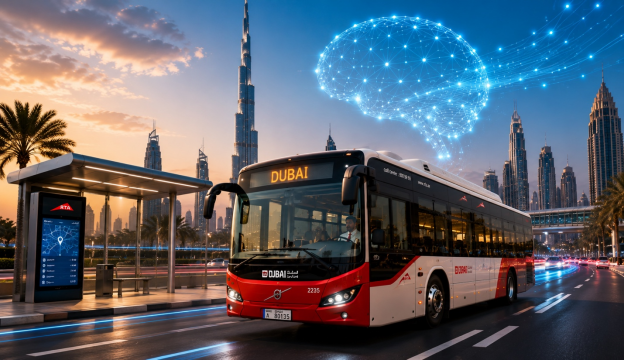
Dubai’s Roads and Transport Authority has just changed that. The RTA has launched a new AI-powered system specifically built to manage and operate the entire bus fleet dynamically, in real time, across the full range of conditions that a city like Dubai throws at its transport network every single day. It sounds technical. But what it actually means for the person waiting at a bus stop is surprisingly simple: the bus is more likely to show up when it is supposed to, and when something goes wrong somewhere in the network, the system responds faster than any human team could.
More Than a Thousand Buses, All Watched at Once
The scale of what has been deployed is worth understanding. The AI system monitors more than 1,100 buses simultaneously, all the time. Every bus in the Dubai public fleet. The system knows where each one is at any given moment, whether it is running on schedule, how many passengers are on board, and what the traffic conditions look like along its route. It is processing all of that information continuously and using it to make operational decisions that keep the network running as smoothly as possible.
What makes this genuinely different from what existed before is not just the monitoring. It is the responding. The system has been built to handle twenty-six different operational scenarios – the kinds of real-world situations that test any transport network. A bus breaks down during rush hour. A major event finishes and thousands of people suddenly need to travel from the same location. A sandstorm reduces visibility and slows traffic across large parts of the city. A route sees an unexpected surge in passengers on a particular day. In the old way of doing things, a human dispatcher would need to notice the problem, assess it, make a decision, and communicate an instruction. All of that takes time, and time is exactly what passengers stuck at a bus stop do not have.
With the AI system, the response happens faster. The system detects the situation, matches it against the relevant scenario, and either recommends or directly implements the appropriate operational response. A bus from a lower-demand route gets redirected to cover a gap. Schedules get adjusted before the knock-on effects have time to build up into something that passengers actually feel. The network stays flexible even when conditions are not.
Twenty-Six Scenarios Might Sound Like a Lot – It Is Not Enough
Here is something that anyone who has ever managed a complex operation will immediately understand. The problems you plan for are rarely the ones that cause you the most trouble. It is the combination of problems, the unexpected timing, the situation that does not fit neatly into any category you prepared for, that tends to really test a system. The fact that the RTA has built this AI around twenty-six distinct operational scenarios is impressive. But what is more impressive is that the system is designed to handle combinations of those scenarios simultaneously, because that is what real operational conditions actually look like.
Think about what happens on a day when there is a big event at one of the stadiums, there is also roadwork affecting two major bus routes, and it is a Friday afternoon when passenger numbers across the whole network spike anyway. A human dispatcher managing all of that at once is overwhelmed. The AI system is not. It is running all twenty-six scenarios in parallel, watching the full network, and making adjustments across multiple routes simultaneously without losing track of any of them. That is not something a human team can replicate at scale, and it is exactly why this kind of technology matters in a city that moves as many people as Dubai does every single day.
This Is About People, Not Just Technology
It is easy to write about AI bus management systems in a way that sounds impressive but feels distant, like something that matters to engineers and government officials but does not really affect ordinary life. That would be the wrong way to think about this. The people who feel the difference most directly when a bus network runs well are the people who have no alternative. The worker who cannot afford to be late. The elderly resident who cannot drive and cannot afford a taxi every day. The student who has to make a connection to get to class on time. These are not edge cases. They are a significant part of the population of this city, and the reliability of the bus network has a direct and daily impact on the quality of their lives.
When the AI system prevents a cascading delay by catching a problem early and rerouting resources before the queue at the bus stop has even formed, that is not a data point in an operational report. That is someone getting home on time. That is someone making their shift. That is the city working the way a city should work for every single person in it, not just the ones with a car or a metro station nearby. Dubai has invested in making its most visible infrastructure world-class for years. The decision to apply the same level of ambition to its bus network – the infrastructure that serves the most people and the most essential journeys – is one of the most meaningful things the RTA has done in a long time. It just happens to also be powered by artificial intelligence.
Contributed by GuestPosts.biz