


Dubai Air Taxis Are No Longer A Dream – They Are Happening This Year
This Is Not Science Fiction Anymore
If someone had told you ten years ago that Dubai would have certified flying taxis before the end of 2025, you probably would have smiled politely and changed the subject. It sounded like the kind of bold prediction that tech optimists make at conferences and that quietly disappears when reality sets in. But here we are. Dubai has just certified the world’s first vertiport for commercial air taxi operations, and the city is now on track to launch actual paying passenger services before the end of this year. Not a pilot programme. Not a government test flight. Real commercial air taxi services that real people can book and ride.
The vertiport that made history is called DXV and it sits near Dubai International Airport. It has received full regulatory certification from the General Civil Aviation Authority and from Skyports Infrastructure, which makes it officially the first vertiport of its kind anywhere in the world to clear all the approvals needed for commercial operations. That is not a small thing. Aviation certification is one of the most demanding regulatory processes in existence, and the fact that Dubai pushed this through before any other city on the planet tells you everything you need to know about how seriously the emirate is taking this.
So What Exactly Is a Vertiport?
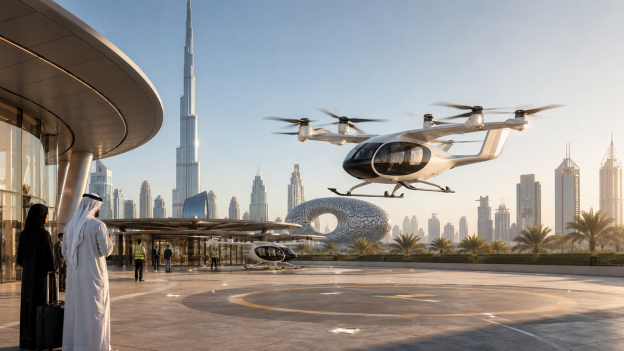
Think of it as an airport, but designed specifically for electric vertical take-off and landing aircraft – the kind of small, quiet, multi-rotor aircraft that companies around the world have been developing for urban travel. Instead of a runway, you have a landing pad. Instead of a massive terminal, you have a compact facility where passengers check in, wait briefly, and board their aircraft. The DXV vertiport covers 3,100 square metres, which is compact by any airport standard but more than enough to handle the volume of traffic that air taxis will generate in the early stages of the network.
And the numbers around that traffic are genuinely impressive. DXV alone is expected to handle up to 170,000 passengers per year once operations are running at full capacity. That is not the total network capacity. That is one single vertiport near one airport. When you add the second vertiport currently under construction at Dubai Marina, plus the sites being developed at Dubai Mall and Palm Jumeirah, you start to get a sense of what Dubai is actually building here. This is not a novelty attraction or a tourist gimmick. It is a serious piece of urban transport infrastructure designed to move large numbers of people across the city through the air.
Why Dubai and Why Now
The honest answer is that Dubai has been preparing for this for years. The Roads and Transport Authority has been working on the regulatory framework, the infrastructure plan, and the operator partnerships that make commercial air taxi services possible long before the rest of the world started treating urban air mobility as something that might actually happen in the near term. While other cities were hosting panel discussions about the future of flying taxis, Dubai was quietly getting the permits, building the facilities, and lining up the partners needed to make it real.
There is also a practical logic to why Dubai makes so much sense as the city where this launches first. The distances between key locations in Dubai are significant. Traffic at certain times of day is a genuine challenge that costs residents and visitors real time every single day. The city has the financial infrastructure, the regulatory agility, and crucially the willingness to try new things at scale that most cities simply do not have. When you combine all of that with a government that has explicitly committed to making Dubai the most advanced city in the world for smart transportation, you get a place that is genuinely ready for something like this in a way that very few other cities are.
What the Network Will Look Like
The four confirmed vertiport locations – DXV near Dubai International Airport, Dubai Marina, Dubai Mall, and Palm Jumeirah – are not random choices. They connect some of the busiest and most frequently visited destinations in the city. Dubai Mall gets more than 100 million visitors a year. Palm Jumeirah has always had a connectivity challenge because there is essentially one road on and off the island. Dubai Marina is one of the most densely populated residential areas in the emirate. And the airport, of course, is where millions of people arrive and need to get somewhere quickly. Linking these four points through an air network creates immediate practical value for enormous numbers of people from day one.
The journey experience itself will be unlike anything currently available in the city. These aircraft are significantly quieter than helicopters, which matters a great deal in built-up urban areas. They are electrically powered, which aligns with Dubai’s sustainability commitments. And the flights between these locations will take minutes rather than the thirty, forty, or sometimes sixty minutes that road travel between the same points can take during busy periods. Booking will work through an app, in the same way you book a car today. You arrive at the vertiport, you board, you fly, you land, you continue your day. The friction in that process is designed to be minimal from the start.
A City That Does Not Wait
What strikes you most about this story is not the technology itself, impressive as it is. It is the speed. Somewhere else in the world, air taxis are still in the discussion phase. Cities are still commissioning feasibility studies and consulting stakeholders and debating whether the infrastructure investment makes sense. Dubai certified its first vertiport, confirmed commercial launch within the year, and broke ground on three more sites before most cities had finished writing the terms of reference for their first working group. That is just how Dubai operates. It decides, it builds, and it opens. And then the rest of the world comes to see how it was done.
If you live in Dubai, pay attention to the skyline over the next few months. Before the year is out, you will see something moving through the air above this city that was not there before. Not a plane. Not a helicopter. Something quieter, smaller, and far more significant than either. The age of the air taxi has arrived, and as usual, it arrived in Dubai first.
Contributed by GuestPosts.biz